Showing posts with label Study Abroad. Show all posts

Monday, September 19, 2011

Crusader Castles

As a Christian, I have always avoided studying the Crusades, because they represent a terribly misguided and embarrassing span of history. I know that the Crusades are of vital importance to any study of the Middle Ages, but they make me uncomfortable. Thousands of people did some really awful things to other people, all in the name of Jesus Christ. Wow. That sucks. It seriously makes me sick. Christianity as a whole was so messed up in the Middle Ages, and though the Crusades might have begun with a noble purpose, these campaigns ended up as a giant excuse for genocide - even of fellow Christians.

"Angel Leading the Crusaders" by Gustave Dore
The problem was that the Church's clergy made promises that they had absolutely no authority to make. They considered themselves like God, so much that they took upon themselves the power to decide who would go to heaven and who to hell. They promised peasants, soldiers, and noblemen alike, that if they died while on the "Holy Crusade," they would be guaranteed direct passage to heaven. NO ONE has the authority to decide that but God. [The way to heaven is much simpler than fighting a battle, all you have to do is acknowledge that you're not perfect, and trust in Christ's sacrifice and resurrection - that He paid the price you owed but could never have paid on your own. It's that easy. Ask me if you wanna know more.]

There is so very much more to the Crusades, but I will leave that to a few other future posts. For now, I'd love to share with you some of the castles I got to visit this Summer while studying abroad in Jordan and Israel, and a little bit about how we can learn from them.

Montreal Castle (now called Qal'at ash-Shawbak), in Jordan, was built in 1115 by King Baldwin I of Jerusalem. It sits on a hill rising above the plain of Edom and controlled a trade route from Syria to Arabia. The castle's inhabitants drew their water from a spring at the bottom of the hill, accessed by a long, steep tunnel dug down through the hill. Saladin captured Montreal Castle in 1189, but only after a siege of nearly two years.

Kerak, not to be confused with Krak des Chevaliers of Syria, stands north of Montreal Castle and east of the Dead Sea. Kerak is a massive castle, constructed in the 1140s, which controlled trade routes from Damascus to Egypt and Mecca. It was besieged beginning at the Battle of Hattin in 1187, and captured (due to treachery on the part of the governor's wife) in 1189.

Qasr al-Azraq (the "Blue Fortress") is a mysterious basalt castle located at an oasis in the northern Jordanian desert. Historians don't know when it was originally built, and whether by the Romans or Nabateans, but it was extensively renovated in the 13th century (and Jordan doesn't have the funds to excavate it yet). Interestingly, T. E. Lawrence ("Lawrence of Arabia") used the castle as his headquarters from 1917-18.

Qasr Kharana, though not a true castle, is an Islamic style, fortified desert mansion built in the eighth century, by caliph Walid I. He probably used this palace to hold councils or celebrations with his tribal leaders. His favorite few might then be taken to the nearby mini-castle-bathhouse-spa for a private retreat. All in the middle of the desert. Go figure.

Nimrod's Fortress is a gorgeous and sprawling crusader fortress built by the nephew of Saladin in 1229 AD, in the Golan Heights north of the Sea of Galilee. It is also called "Castle of the Large Cliff," as it sits atop a high hill with a cliff rounding one side. The fortress was used sporadically until an earthquake destroyed it in the 18th century.

Vadum Iacob ("Jacob's Ford"), built in 1178 by King Baldwin II of Jerusalem, was the last castle we visited. Though it may appear horribly anticlimactic, as hardly any of the castle's remains are readily visible, it tells one of the most fascinating stories of the Crusades, and of Crusader Archaeology. But, that story must wait until another time. For now, suffice it to say that it involves greed, arrogance, a mighty battle where one side was completely annihilated, and the remains were left untouched for over eight hundred years.

The castles built in the Middle East by the Crusaders and their Muslim adversaries are some of the best examples of Medieval castle-building technology and design. This was a period when the greatest developments occurred on both sides of castle construction, as the Crusaders learned certain techniques from the Muslims and vice-verse. It was an amazing privilege for me to walk through the courtyards, chambers, and corridors constructed so long ago by these driven warriors of the Crusades (and earlier eras), even if we only had a short while to explore each one. (Literally, when we arrived at most of these fortresses, our professor announced, "Okay, guys, you've got twenty minutes to explore this castle!" We had a very tight schedule...)

The Crusades in general might still make me a little uncomfortable, but I'm warming up to studying them (besides, I'm a Medieval Studies major - I have no choice). They may be embarrassing to the Christian faith as a whole, but they left a legacy of cultural, technological, and architectural advancements. We can learn a great deal from the mistakes and  successes of this much-debated era of history, when Europe and the Middle East, Christianity and Islam, clashed.


Photo credits: Deanna Leiber, unless otherwise noted

Saturday, August 13, 2011

Petra: the Original Rock City

As I mentioned in my previous post, I had the amazing privilege of touring the Middle East for five weeks this summer, as a Study Abroad trip with my university. We visited Egypt, Jordan, and Israel. We would have visited Syria and Turkey as well, but because of the intense conflict in Syria, we had to cut that week out of our itinerary, shortening the trip from six to five weeks.
"The Treasury"

We spent nearly a week in Jordan, and in the midst of half a dozen Crusader castles, museums, and a ruined city or two, we spent a day at Petra. Petra is Greek for "rock," which is quite appropriate as the entire city was carved out of stone cliffs. You may be familiar with Petra's most famous facade, misleadingly called "The Treasury," (Bedouins thought the Egyptians had hidden treasure in the facade, and the name just stuck) which was used in the film Indiana Jones and the Last Crusade. This is only a tiny part of the whole of Petra, and the expansive portion of the city which visitors can now explore is actually estimated to be only 11% of the entire city. Wow.

Petra was likely founded as the capitol of the Nabataean civilization around 600 BC, but most of the ruins date to between 300 BC and 400 AD. The city flourished and became wealthy as a major stop on a land trade route and its architects and artisans were strongly influenced by their great neighboring civilizations, the Egyptians, Greeks/Romans, and Syrians. By the first century BC, Petra took on even more characteristics of neighboring cultures, resembling a Hellenistic city with its newly minted coins and new amphitheater. In 106 AD, Petra was absorbed into the Roman Empire while also at the height of its splendor, but by the fourth century AD, the city declined considerably, as trade routes shifted to the sea.

Fulfilling Petra's water needs was a vast and intricate system of miles and miles of aqueducts and thousands of cisterns, all carved into the stone cliffs surrounding the city. Terracotta pipes were added during the Roman age, making the system even more efficient. Because of the constant threat of flooding (inherent to a city built in a canyon), Petra's builders also constructed a series of dams to divert excess water away from the city. Petra was permanently crippled, however, when an earthquake in 363 AD destroyed many buildings and damaged the water system.

Though Petra fell into deep decline after the earthquake, it remained a religious center and curiosity throughout the Middle Ages. The remains of a Byzantine church, including some stunning mosaics, stand at Petra. Johann Ludwig Burckhardt was the first European to visit the site, in 1812, when he paid some Bedouins to guide him there. Petra was first excavated and surveyed in 1929.

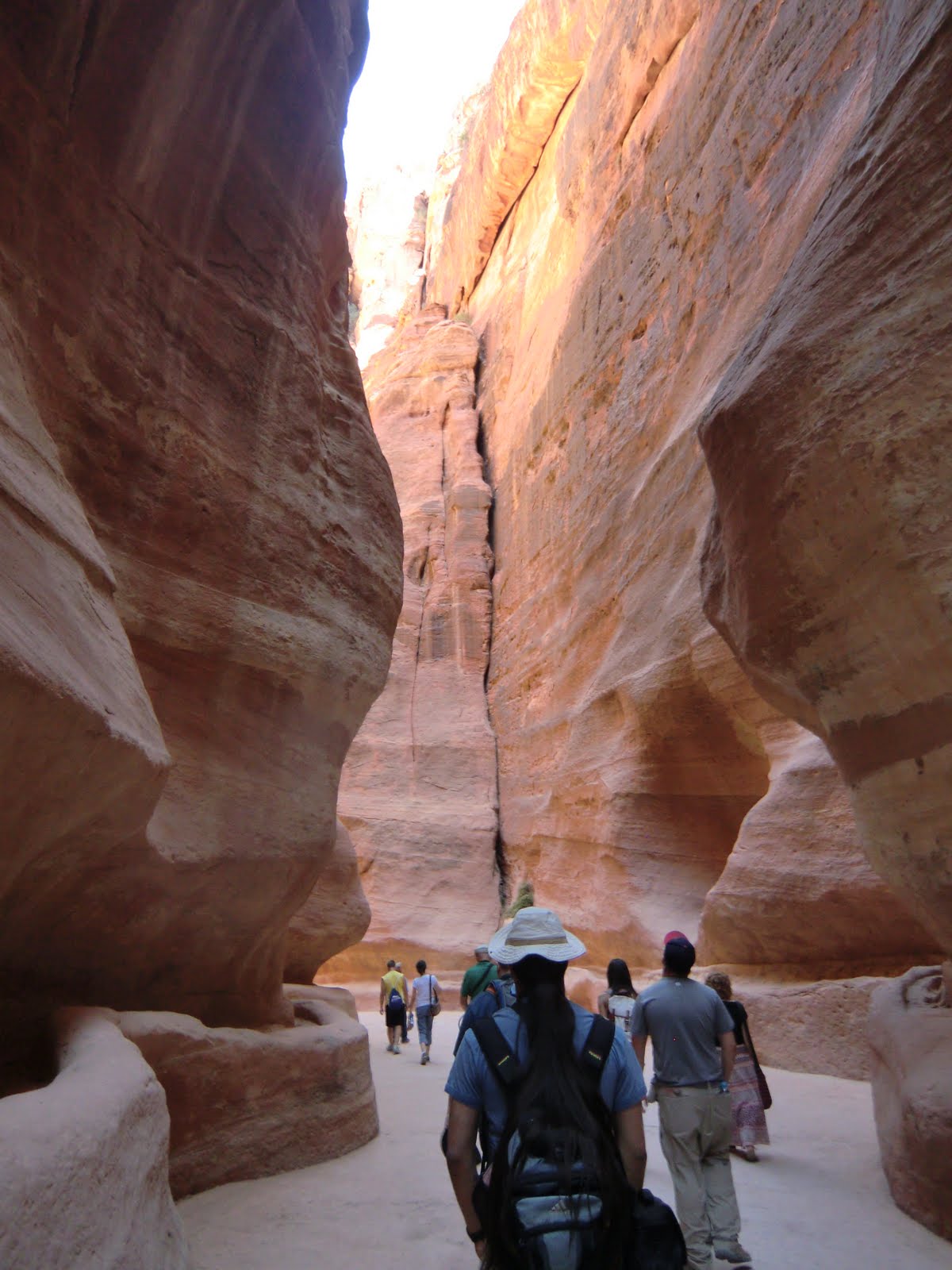
Al-Siq (the narrow canyon leading into Petra)
It's funny how out of all the films to feature a part of Petra, the one remembered most (by the West and by Jordan) is Indiana Jones and the Last Crusade; My group's Jordanian tour guide has been in the business for over thirty years and was actually present the day that Sean Connery, Harrison Ford, and crew filmed the five minute scene showing the Siq (the long, narrow canyon leading into the city) and the facade of "The Treasury." Also documenting the film were the "Indiana Jones Gift Shop" and the "Indiana Jones Snack Shop" near the site entrance.

As we rounded the corner at the end of the Siq and The Treasury came into view - real, gorgeous, and towering right in front of me - I knew this was going to be an amazing day. We ogled over this most famous of Petra's monuments for a few minutes before moving down the canyon, where it opens up to the "downtown" part of the city.  The cliff faces are covered with layer atop layer of tomb/dwellings ("here's my bedroom, and my grandma's buried under the floor over there..."), some magnificently carved and gigantic, while others were small and simple. We climbed up into one of the smaller dwellings to better grasp what it might have been like to live there. The sandstone walls are rippled with various colors, ranging anywhere between yellow, white, black, red, or blue, creating dazzling, natural "interior designs."

my view of the cardo from atop the cliff
Next, we climbed up to the "Urn Tomb," so-named for the giant urn carved into the top of the facade. This tomb was later re purposed and used as a church, when the city converted from its Pre-Islamic Arab religion to Christianity. A couple of the people from our group discovered a nearby stairway carved into the cliff (one of thousands in Petra) and we spent about a half hour detour up the cliff, following this precarious stair-trail. In the end, we could have climbed further, but time forbade us.

After more explorations, including the cardo, or "heart" of the city (its main street), we climbed over 700 steps up to "The Monastery," atop the cliff above Petra. This facade is the largest in the whole city and was later used as a monastery, hence the name. This climb and the jaw-dropping facade and views at the top were the definite highlight of the day. It just dumbfounds me to imagine what Petra must have looked like during its height. Wow.

The Monastery
We descended back down into the canyon of Petra and made our way to the exit, leaving behind my absolute favorite single site of the entire trip. We did not even have time to see all of what is open for tourists, and I definitely want to return and explore the city again some day.

I highly recommend a day (even two) at Petra for anyone who travels to the Middle East. You will never forget this magnificent, ancient city.


Photo credits: Deanna Leiber

Sunday, June 26, 2011

Egyptian Hieroglyphics: the Basics

When I was younger, I loved to study the Ancient Egyptians. I'm still not sure why, but their art, architecture, and culture fascinated me. I could spend hours as a ten-year-old, reading my dad's four inch thick college textbook about Ancient Egypt. Some time later, my interests shifted into the Middle Ages and I abandoned researching Egypt for several years, forgetting much of my knowledge with time.

My interest was renewed, however, when I signed up for a Middle East Study Abroad Trip with my university for this summer. The trip was scheduled to tour Egypt, Jordan, Syria, a touch of Turkey and maybe Lebanon, (Syria, Turkey, and Lebanon we had to cut because of the revolution in Syria) and then Israel. It would last for six weeks, two of which would be spent working on the Bethsaida Archaeological Dig in Israel.

Wow.

Luxor Temple facade
What an amazing opportunity! The group of students and the professor leading the trip met every other week over the spring semester leading up to the trip, and it was not until a few weeks before our departure date that it finally sunk in that I would actually be going. With the realization that I would truly observe monuments such as the Giza Pyramids, Luxor, Petra, and countless Biblical sites (including Jerusalem), came the realization that I had a lot of research to do! I needed to brush up on all that precious Egyptian history and my Biblical geography. With studying for finals, and then a busy family vacation in Florida filling my time before the trip, the victorious flight of my researching glider barely got off to a running start and never quite leapt over the cliff's edge and into the air.

I did, however, begin learning the basics of deciphering Ancient Egyptian Hieroglyphics.

At the most basic level, Egyptian Hieroglyphics are alphabetic letters. They are difficult to correspond to the sounds of the English language, and scholars can really only speculate as to how they were really originally pronounced. The chart at right shows the generally-agreed-upon Hieroglyphic alphabet. It's not too difficult to learn, as it is comprised of only thirty characters, some of which roughly arbitrarily (for English-speakers, anyway) relate to their represented sound, such as the lion representing the "L."

Rosetta Stone
Archaeologists and historians studied Ancient Egyptians throughout the Middle Ages and into modern times. Many people claimed to have deciphered hieroglyphics, such as Arab historians in the ninth and tenth centuries, but their meanings remained mysterious until 1799, when Napoleon discovered the Rosetta Stone during his invasion of Egypt. The Stone is a basalt stele with the same inscription in three different scripts. The first language was Greek, the second was Egyptian hieroglyphics, and the third was a sort of cursive Egyptian script (though not the same as cursive hieroglyphics). It was not until 1820, when Jean-Francois Champollion noticed that the hieroglyphics contained certain characters in little bubbles (called cartouches) which roughly corresponded to the placement of the names Cleopatra and Ptolemy in the Greek inscription...

Through comparing the names and the way in which they were spelled in Egyptian hieroglyphics, Champollion was able to determine ten of the letters of the Egyptian alphabet. From there, he deciphered the rest of the alphabet, as seen above, and the rest is "history!"

One thing that makes Egyptian hieroglyphics a bit confusing, though, is the direction in which it is read. hieroglyphics can be written both in columns and rows, and it can be read from right to left, or left to right. Confusing, isn't it? Well, the Ancient Egyptians did leave us two clues for knowing in what direction to read:
First, you always read from top to bottom. Easy.
Second, notice which way the characters (people, animals, etc) are facing. Read toward them.
The relief above is from the inner sanctum of the Luxor Temple, and the characters in the inscription face left, so you read them from left to right, top to bottom.

Now you can read Egyptian hieroglyphics, right? Well, of course, it's not that easy. The problem is that the characters can be alphabetic, phonetic, or determiners, even in the same word. Yeah. It is quite a bit more complicated than I thought, too! Let me give you a demonstration.

In the above sample, only the "kh" and "r" are alphabetic. The loaf/brick/thing, scythe, arm, and spear are phonetic, and the man is the determiner (telling us that this word relates to the mouth).

So, yes. Egyptian Hieroglyphics are actually rather sophisticated and very difficult to understand. I had no idea what I was getting myself into by diving into the world of hieroglyphics, but I now have a greater appreciation for the innovation of the Ancient Egyptians.

Now that you've got the bare basics of reading Egyptian hieroglyphics, you should attempt to master it with the book Egyptian Language: Easy Lessons in Egyptian Hieroglyphics by Sir E. A. Wallis Budge.