Showing posts with label Middle Ages. Show all posts

Sunday, April 13, 2014

6 Lessons We Can Learn from the Ozark Medieval Fortress

or, How NOT to Build a Medieval Castle in 21st Century America.


Artist's rendering of the completed Ozark Medieval Fortress, originally projected for 2030
A few years ago, a team of investors and enthusiasts led by Michel Guyot broke ground on a 20-year building project to construct a 13th century castle in the middle of the USA. They called it the Ozark Medieval Fortress. It was an ambitious plan to build an entire castle, with towers, walls, and a great hall, using only the methods they would have used in the middle ages. When I heard about this, I was ecstatic. I'd seen a documentary about a similar project, Chateau de Guedelon, in France and thought it was super cool, but thought I'd probably never get to see something like that in person.

But the Ozark Medieval Fortress was only a few hours away, in northern Arkansas! I got to visit once in each in 2010 and 2011, and was hoping to intern there in 2012, but that's when their problems came clearly to the surface in the form of the message which appeared on their website early in 2012: "Opening in 2012 delayed due to financial reasons. We are seeking American financial partners."

They never re-opened.

In looking back at the way the whole Ozark Medieval Fortress was run, I think there's a lot we can learn, and maybe get it right with a stellar medieval castle-building project somewhere in the future. These are the 6 big ideas on what I think was done wrong at the Ozark Medieval Fortress, and how they could be done right, next time.


Breaking limestonewith a chase-masse
6. Don't Start a Risky, Multi-Million Dollar Project in the Middle of a Recession.

Granted, the project's financiers were from Europe, and the economic downturn hadn't really hit Europe yet when the project began to take shape in 2008. The downturn doesn't seem to have been really affecting European economies even when the Fortress opened in 2010. But the recession was certainly in full swing in America at that time. And the Fortress was slated to be built in Lead Hill, Arkansas, smack in the middle of financially-struggling America. Maybe this was taken into consideration, but it seems that it would have been wiser to perhaps wait until a time when people [i.e. - potential visitors] would be more willing to part with their hard-earned dollars to visit a castle in progress, especially when there really wasn't much to look at (in the fortress itself) in the first season, with most of the walls less than 2 ft tall, and maybe 8 ft at the highest sections.

5. Don't Start an Expensive Project with Out-of-Touch Investors.

The project's investors were all from France, and it seems that many of them were or are also involved in the Chateau de Guedelon project. On one hand, that's a good thing. The investors were already steeped in the French culture which the Ozark Medieval Fortress was supposed to embody. The problem, I think, is that they were French, and not American. Perhaps they were more familiar with French history, culture, and the middle ages, but they were probably not familiar with American culture, and how to market a medieval castle building project to an American audience.

Who might have been better investors? I bet a few universities with Medieval Studies programs might have been interested in helping to sponsor the project. Or just wealthy Americans in general - but someone who was familiar with the culture and country in which the project was to be carried out.
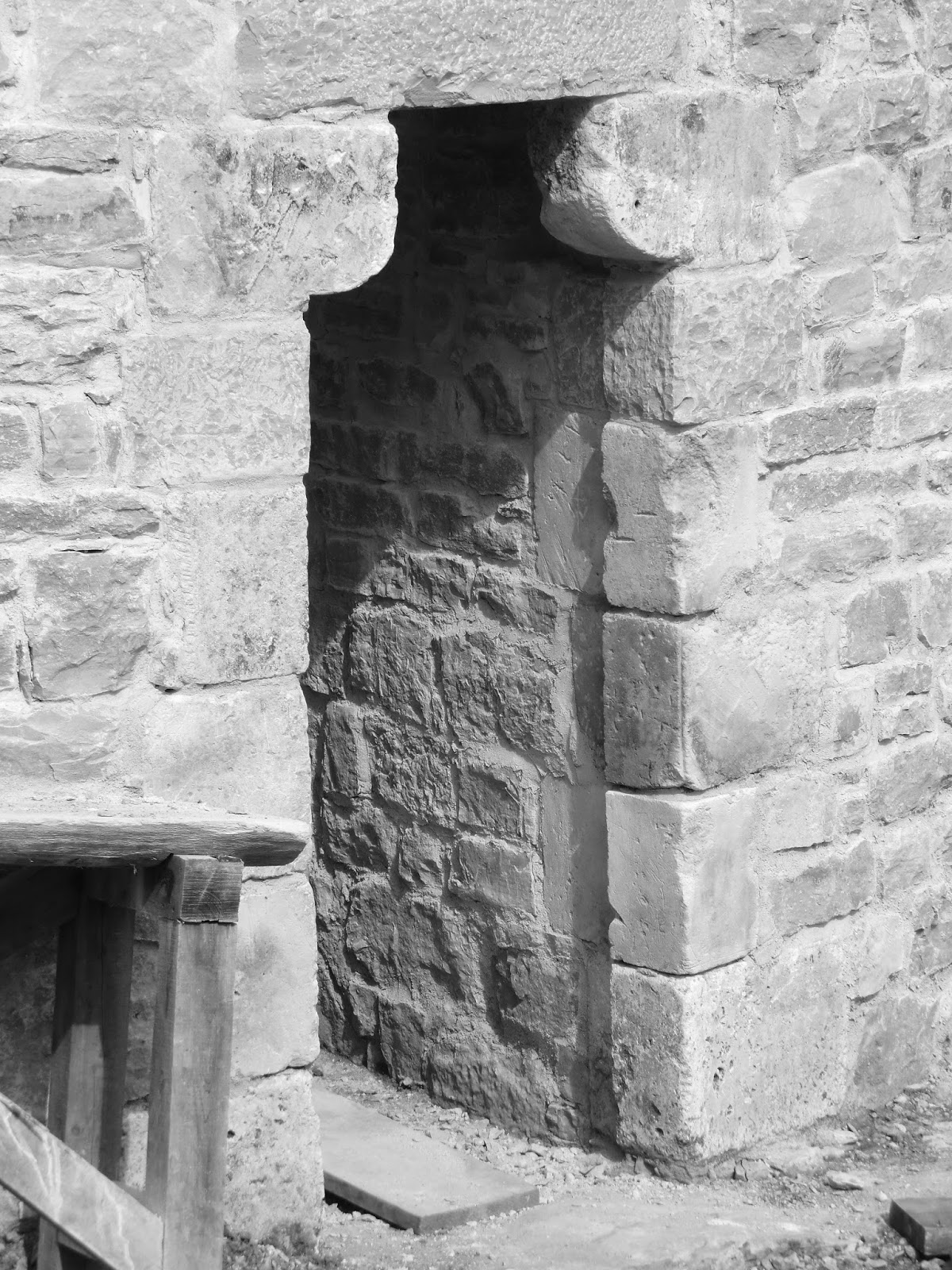
A tower doorway at OMF
4. Don't Start an Expensive, Tourism-Based Project in the Middle of Nowhere.

Why did they pick Arkansas, of all places? Convenience. They touted on their website that the landscape was very similar to that of Southern France, and also happened to have a limestone quarry, which is essential to the castle building, and it was even conveniently only 30 miles south of the touristy Branson, MO. Branson would be a great location for an attraction directed at seniors or families with small children, but Branson, and the entire Midwest is not exactly a place known for its interest in European History. The castle was not at all handicapped accessible and was not exactly a safe environment to encourage young children to run about. These conditions essentially exclude 80-90% of all of Branson's typical visitors.

So what might have been a better location? Somewhere with beautiful scenery that could be compared to somewhere in Europe, but somewhere with a larger population nearby, somewhere that attracts international visitors, and somewhere with a population more inclined to be interested in European history enough to want to visit a Medieval European Style Castle-in-Progress. Good candidates might include locations in Colorado, California, Washington State, Florida, or upstate New York.

3. Don't Translate Your Written Materials Directly from French. Or Any Other Language.

The relationship of the Chateau de Guedelon with the Ozark Medieval Fortress was something akin to a big brother - little sister type of relationship, with much of the information and planning for the OMF coming directly from the French project. This is helpful in that the instructions on masonry and signage come from experts, but this arrangement also caused some problems in translation. Foremost among these was the press release given to news media throughout America to announce the opening of the Ozark Medieval Fortress. Somehow, the facts got mixed up so that the release bragged that the Ozark Medieval Fortress would be "a genuine, full-sized, fortified castle, with 24-foot high towers, a drawbridge, and 6-foot wide stone walls." That sounds rather unimpressive, and not like a full-sized castle, or anything worth visiting. In reality, the walls were 6 feet thick and 24 feet tall, and the tallest of the towers was planned to be over 70 feet tall.

Other instances of translated material not turning out so well was in the signage scattered throughout the castle site. Several had typos or were worded awkwardly, but one in particular explained the "wise witch." This title is perfectly innocuous in France, but in America, the word "witch" has certain very negative connotations. A better English translation would be something like "wise woman" - the village expert on herbs and remedies.

These problems could have all been avoided by assuring that a native English speaker wrote and/or translates all of the written material associated with the Ozark Medieval Fortress.

2. Don't Open A Niche Attraction Without Knowing your Market and How to Appeal to it.

What is an "Ozark Medieval Fortress" anyway? Some people don't even know what "medieval" means, but they're sure going to know what a castle is. "Fortress" brings to mind a civil war fort or other military construction, and not necessarily a castle. Even the word "Ozark" carries a certain stigma with it. The castle could have been named just about anything other than "Ozark Medieval Fortress," as long as "castle" or "chateau" was in the name.

On the castle's website and in their one advertising campaign, the motto was,
"They're building it. Come see it!"
The point of a motto is to stick in peoples' minds and convince them to visit the castle, but I think they could have come up with something far better.

I think the castle's advertising would have been far more effective if the question of "who would want to visit a castle construction site in America?" had been longer considered. They might have chosen a better geographic location, and might have realized that their best target audiences would probably have been students and academics, as well as fans of historical reenacting and fantasy genres.

1. Don't Run a History-Based Attraction Without an Expert Advisor on Board.

Though the project certainly had many staff and volunteers who were well versed in the restoring and building of castles, and even some who were quite familiar with reenacting, it seems that for the most part, there were no true experts involved in the oversight of the Ozark Medieval Fortress. From what I can find, the main tour guide at the castle (who also served as its official historian) had a Bachelor's degree in European History and had attended a summer program on the Middle Ages in Germany. He certainly was very knowledgeable on the Middle Ages, but such credentials hardly compare to someone with a Master's or PhD in Medieval Studies or Medieval History. And no such expert was to be found on the Ozark Medieval Fortress Team. Other good candidates might have been an archaeologist who specialized in medieval sites, an experimental archaeologist, or a historical architect.

If they had held such an expert on staff or even just as an advisor, perhaps the whole project would have turned out differently.


A few news articles have covered the closing of the Ozark Medieval Fortress, including the New York Times, but for the most part it has unfortunately gone unnoticed. I would love to see someone pick up the unfinished castle and breathe new life into it, and I think it could be salvaged. But whether someone buys and revitalizes the Ozark Medieval Fortress, or starts a new project somewhere else, I hope they won't repeat the same mistakes. 

Disclaimer: Some of this information has been very difficult to research, since the Ozark Medieval Fortress website is gone. I might have missed some important information, and I really want this to be an informed and accurate blog, so if you know of any information that I missed that might change what I said, or if I got something wrong, please let me know. I wrote this article to show how we can use the Ozark Medieval Fortress as an example and learn from its problems, so that the next time a project like this is begun in America (or anywhere else), it might have a greater chance at success.

Monday, January 13, 2014

Conwy Castle and the Guide to Medieval Europe

Conwy Castle, Conwy, Wales, UK
Something strange came over me when I visited a castle in Wales last summer. It was on June 22, and I had been travelling in the British Isles for the previous seven days, but this was my first full day on the Welsh side of the Irish Sea, and I woke in the Castle Hotel (not an actual castle, though quite historic in its own right) inside the medieval walls of the town of Conwy (pronounced Conway). The Castle Hotel stands just down the street from Conwy Castle, built lightening-fast (by medieval standards) from 1283-1289 by England's King Edward I.

View from the Conwy Castle of the Town and the River Conwy.
Conwy Castle is unique because it not only stands as one of the best examples of late 13th-early14th century military architecture in Europe, but it is also in unusually good shape for being a fortress built by occupational forces (the English) in contested territory (Wales). Though the castle endured a siege and did change hands more than once throughout the Middle Ages and Renaissance, it sustained very little structural damage, was never extensively remodeled, and is remarkably well preserved today. Thus, the castle retains a strong sense of its own medievalness.

This is what struck me as I explored the corridors and climbed the towers of Conway Castle on that Saturday in June: the castle felt entirely medieval, with just enough signage to be informative, but not so much to be intrusive, just enough restoration to give a sense of its original purpose and finesse, but not so much as to feel staged or kitschy. I found it easy to imagine how the various chambers and wards might have looked in the castle's heyday, the straw strewn wood floors and tapestried walls and fire lit halls bustling with soldiers and servants, and occasionally visited by the king himself. I looked out the archer's perches high in the towers and wished I was there a couple hundred years ago so I could try shooting my own English longbow through the narrow arrow-loops at imagined adversaries down below.


Tower view of the inner and outer wards of Conwy Castle.
This fantastic experience of the medievalness of Conwy Castle stayed in my mind for the rest of my trip, but the other castles I visited afterward did not offer the same sort of transportation back to the middle ages like Conway did. The other castles had been updated and destroyed and rebuilt and added onto, until the only thing medieval that remained was the foundation, or the stories of what had happened there five hundred years ago. It wasn't the same. I wanted that Conwy Castle experience, and I knew there were lots of other well preserved medieval places to be found, but I didn't know where to find them. Plus, many places advertised as "medieval" frankly struck me as none such thing; their medievalness had been long ago remodeled or redesigned and was lost forever.

I came to the conclusion that I wanted to find a guide book for those truly medieval places, not the ones that were once medieval but are now a better monument to Renaissance or Victorian architecture and culture, but a book that pointed out the castles, towns, or other sites which still retain their medieval nature. But no such guide exists. The closest I could find is Richard Barber's 1984 book, The Penguin Guide to Medieval Europe, certainly a densely informative book from an acclaimed author, but not quite the Here's-Why-It's-Medieval-and-Here's-How-to-Get-There kind of guide which I imagined.

Since I couldn't find the kind of guide I was looking for, I'm going to write a Guide to Medieval Europe, myself, or even better, a series of geographically oriented guides, divided by country or region.

This is a huge undertaking. It will not be easy and it will not happen fast. I probably won't even get to the writing stages for a few years yet, but I know I'm not the only one who would make use of, say, a guide to medieval Scotland which not only lists and describes various truly medieval sites, but also includes practical, trip-planning info such as where to stay, how to get there, accessibility, and much more. It's the kind of guide I wish existed, and since it doesn't, I want to offer my bid to fill that void.

So in the meantime, what will I be doing? I'll be gathering lots and lots of information and tips and doing lots of research. Then I will set off to actually visit the places I want to write about, and then I'll set about writing. I'll need all the help I can get throughout the process though. Let me be the first to admit that I don't know everything about the Middle Ages, and no matter how much research I do, or even if I earn a PhD someday, I never will know everything about the Middle Ages. I've only visited a tiny corner of Europe and only seen a handful of the hundreds of medieval sites Europe has to offer. If you have any suggestions on sites, museums, or castles I should include, or any other questions or ideas, please say so in the comments!


(All photos are the property of Deanna Leiber. Do not use them without permission.)

Tuesday, March 13, 2012

Creating a new "Middle Ages"

Even before I knew I wanted to be a medievalist, I knew I wanted to be a writer. I started writing a short story eight years ago, when I was twelve, and quickly decided that it could make an interesting book, though I had no idea where the rest of the plot was headed. The story is about a young woman who wakes up in a prison and has absolutely no memory of who she is or why she is there. She learns that she was captured as a prisoner of a war which has been raging for six years, and she has a long internal battle left just to figure out who she is and what the nature of her involvement in the conflict was before her capture. While she is piecing her past together and trying to escape the prison, an enigmatic sort-of-assassin is searching for something which is very valuable to his king - something worth a massacre just to get his hands on it. He, too, struggles with deep internal conflict and piecing together the mystery of his own past, but his is a vastly different sort of history.
The two have no knowledge of the other's existence, nor any idea of just how closely intertwined their stories already are - nor any hint of the devastating results if they fail to find their purpose.


When people learn that I'm writing a book, they want to know what it is about, and the first thing I tell them is that it is a work of "Historical Fantasy," meaning that it's only "fantasy" in that the story does not take place in our world. Absent are all other aspects of a typical fantasy story: the Fire-Breathing Dragon, Magic, Goblins, or any other fantastic creatures or races. I've christened this story world, "Tellus," which is an ancient name for our own Earth, used most notably in C. S. Lewis' The Space Trilogy. I want to show the relationship between this world and ours; my story takes place when [at least a part of] Tellus is going through her own "middle ages" and the technologies, culture, and societal structures are similar to those of our world's middle ages. That's where the "historical" part of "Historical Fiction" comes into play. And that's what this post is all about: Tellus is not identical to Earth (and no, there will never be any travelling from here to there in any of my stories regarding it. It's not Narnia, it's just another sort of Earth, another sort of idea of what might very well have happened here if our own history was different).

So I have this task of creating a new and alternate sort of "middle ages," one that captures the ideals, histories, and hopes of a world which only vaguely exists in my mind and a little bit on paper. I have this task to bring to vivid and breathing life a world rich enough that my readers could imagine themselves exploring it and having their own adventures, far away from the story I'm telling. I have this task to weave an intricate fabric of societies, clashing cultures, landscapes, architectures, martial arts, religions, languages, and histories. I have this task that is so vast and daunting that it scares the bejeebers out of me. But it also lures me in to seek out the exotic and unknown reaches of this place called "Tellus," to have my own adventure exploring it and filling in the misty blank places with the rich detail of the veins in the leaves of ancient trees and the crumbling grout between the stones of a changing civilization.

The interesting and slightly disappointing part about all of this planning and creating and imagining, is that my readers will only get a little part of it. You see, by creating this vast and detailed description and history for Tellus, I am better equipped to dwell fully in this imagined world while writing the story in my book: better able to articulate why certain people act as they do, or speak with different accents, or hold cultural grudges, or are darker or stockier in build, or why the borders have been drawn as they are. The readers may never get even a quarter of all of the backstories and descriptions, but they will get enough of a taste in my book that their imaginations can freely and wonderfully fill in the rest. And that is exactly the fantastic beauty of reading a book, after all, isn't it?

You have no idea how much I want to jump right into the world of Tellus and describe to you the gorgeous landscapes and rise and development of the current cultures, and give you a taste of the whole complicated story of my book, but I can't. Wouldn't you rather see it for yourself? Wouldn't you rather read it in the faces and travels and fights of Eladar and Kaael, the amnesiac soldieress and tortured assassin of Tellus, as they embark on their life-voyages? While you are waiting for them to be ready to tell their story, why not set out for the exotic corners of your own mind and see what adventures await?


Saturday, August 13, 2011

Petra: the Original Rock City

As I mentioned in my previous post, I had the amazing privilege of touring the Middle East for five weeks this summer, as a Study Abroad trip with my university. We visited Egypt, Jordan, and Israel. We would have visited Syria and Turkey as well, but because of the intense conflict in Syria, we had to cut that week out of our itinerary, shortening the trip from six to five weeks.
"The Treasury"

We spent nearly a week in Jordan, and in the midst of half a dozen Crusader castles, museums, and a ruined city or two, we spent a day at Petra. Petra is Greek for "rock," which is quite appropriate as the entire city was carved out of stone cliffs. You may be familiar with Petra's most famous facade, misleadingly called "The Treasury," (Bedouins thought the Egyptians had hidden treasure in the facade, and the name just stuck) which was used in the film Indiana Jones and the Last Crusade. This is only a tiny part of the whole of Petra, and the expansive portion of the city which visitors can now explore is actually estimated to be only 11% of the entire city. Wow.

Petra was likely founded as the capitol of the Nabataean civilization around 600 BC, but most of the ruins date to between 300 BC and 400 AD. The city flourished and became wealthy as a major stop on a land trade route and its architects and artisans were strongly influenced by their great neighboring civilizations, the Egyptians, Greeks/Romans, and Syrians. By the first century BC, Petra took on even more characteristics of neighboring cultures, resembling a Hellenistic city with its newly minted coins and new amphitheater. In 106 AD, Petra was absorbed into the Roman Empire while also at the height of its splendor, but by the fourth century AD, the city declined considerably, as trade routes shifted to the sea.

Fulfilling Petra's water needs was a vast and intricate system of miles and miles of aqueducts and thousands of cisterns, all carved into the stone cliffs surrounding the city. Terracotta pipes were added during the Roman age, making the system even more efficient. Because of the constant threat of flooding (inherent to a city built in a canyon), Petra's builders also constructed a series of dams to divert excess water away from the city. Petra was permanently crippled, however, when an earthquake in 363 AD destroyed many buildings and damaged the water system.

Though Petra fell into deep decline after the earthquake, it remained a religious center and curiosity throughout the Middle Ages. The remains of a Byzantine church, including some stunning mosaics, stand at Petra. Johann Ludwig Burckhardt was the first European to visit the site, in 1812, when he paid some Bedouins to guide him there. Petra was first excavated and surveyed in 1929.

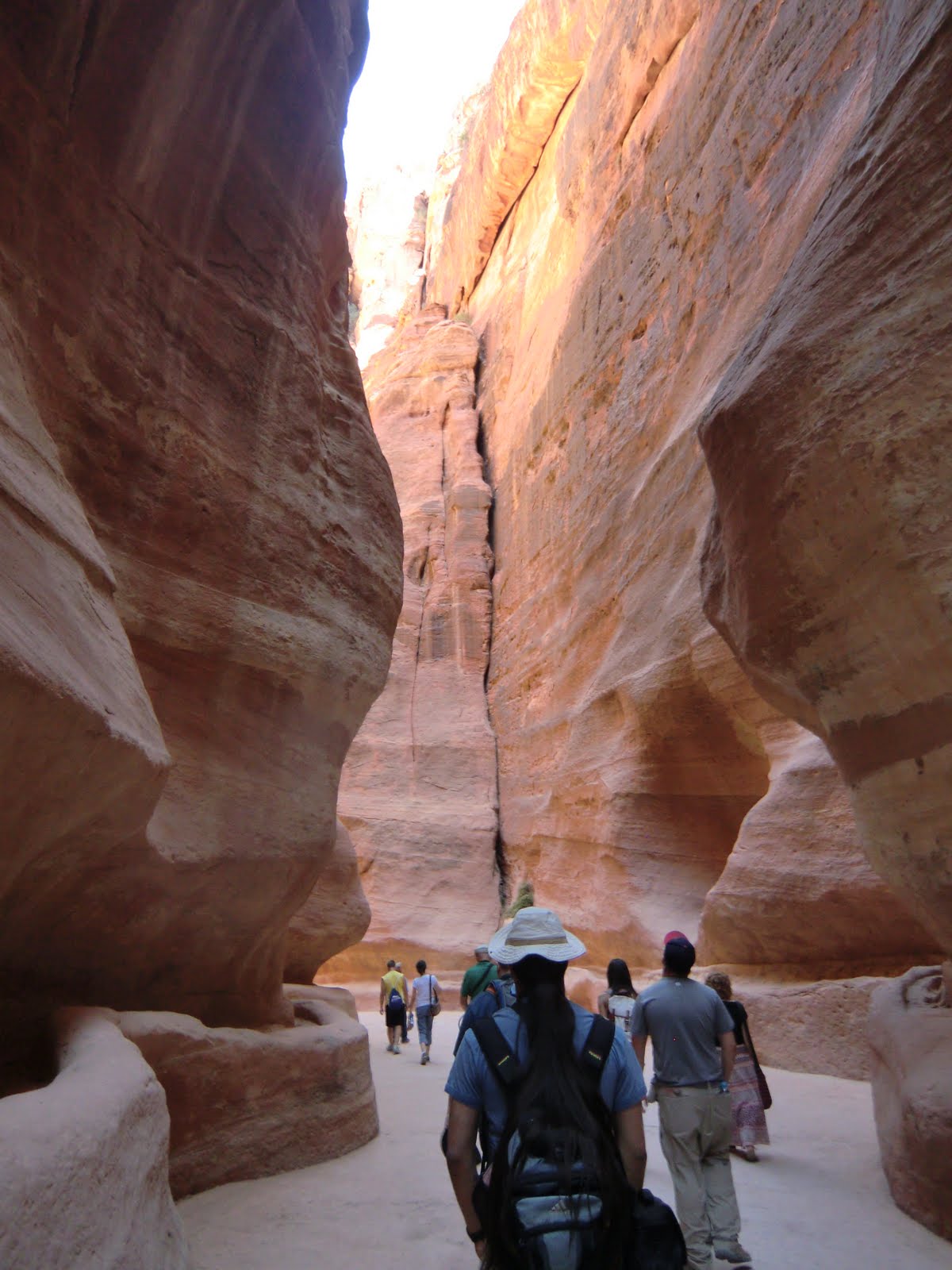
Al-Siq (the narrow canyon leading into Petra)
It's funny how out of all the films to feature a part of Petra, the one remembered most (by the West and by Jordan) is Indiana Jones and the Last Crusade; My group's Jordanian tour guide has been in the business for over thirty years and was actually present the day that Sean Connery, Harrison Ford, and crew filmed the five minute scene showing the Siq (the long, narrow canyon leading into the city) and the facade of "The Treasury." Also documenting the film were the "Indiana Jones Gift Shop" and the "Indiana Jones Snack Shop" near the site entrance.

As we rounded the corner at the end of the Siq and The Treasury came into view - real, gorgeous, and towering right in front of me - I knew this was going to be an amazing day. We ogled over this most famous of Petra's monuments for a few minutes before moving down the canyon, where it opens up to the "downtown" part of the city.  The cliff faces are covered with layer atop layer of tomb/dwellings ("here's my bedroom, and my grandma's buried under the floor over there..."), some magnificently carved and gigantic, while others were small and simple. We climbed up into one of the smaller dwellings to better grasp what it might have been like to live there. The sandstone walls are rippled with various colors, ranging anywhere between yellow, white, black, red, or blue, creating dazzling, natural "interior designs."

my view of the cardo from atop the cliff
Next, we climbed up to the "Urn Tomb," so-named for the giant urn carved into the top of the facade. This tomb was later re purposed and used as a church, when the city converted from its Pre-Islamic Arab religion to Christianity. A couple of the people from our group discovered a nearby stairway carved into the cliff (one of thousands in Petra) and we spent about a half hour detour up the cliff, following this precarious stair-trail. In the end, we could have climbed further, but time forbade us.

After more explorations, including the cardo, or "heart" of the city (its main street), we climbed over 700 steps up to "The Monastery," atop the cliff above Petra. This facade is the largest in the whole city and was later used as a monastery, hence the name. This climb and the jaw-dropping facade and views at the top were the definite highlight of the day. It just dumbfounds me to imagine what Petra must have looked like during its height. Wow.

The Monastery
We descended back down into the canyon of Petra and made our way to the exit, leaving behind my absolute favorite single site of the entire trip. We did not even have time to see all of what is open for tourists, and I definitely want to return and explore the city again some day.

I highly recommend a day (even two) at Petra for anyone who travels to the Middle East. You will never forget this magnificent, ancient city.


Photo credits: Deanna Leiber