 |
| Artist's rendering of the completed Ozark Medieval Fortress, originally projected for 2030 |
But the Ozark Medieval Fortress was only a few hours away, in northern Arkansas! I got to visit once in each in 2010 and 2011, and was hoping to intern there in 2012, but that's when their problems came clearly to the surface in the form of the message which appeared on their website early in 2012: "Opening in 2012 delayed due to financial reasons. We are seeking American financial partners."
They never re-opened.
In looking back at the way the whole Ozark Medieval Fortress was run, I think there's a lot we can learn, and maybe get it right with a stellar medieval castle-building project somewhere in the future. These are the 6 big ideas on what I think was done wrong at the Ozark Medieval Fortress, and how they could be done right, next time.
 |
| Breaking limestonewith a chase-masse |
Granted, the project's financiers were from Europe, and the economic downturn hadn't really hit Europe yet when the project began to take shape in 2008. The downturn doesn't seem to have been really affecting European economies even when the Fortress opened in 2010. But the recession was certainly in full swing in America at that time. And the Fortress was slated to be built in Lead Hill, Arkansas, smack in the middle of financially-struggling America. Maybe this was taken into consideration, but it seems that it would have been wiser to perhaps wait until a time when people [i.e. - potential visitors] would be more willing to part with their hard-earned dollars to visit a castle in progress, especially when there really wasn't much to look at (in the fortress itself) in the first season, with most of the walls less than 2 ft tall, and maybe 8 ft at the highest sections.
5. Don't Start an Expensive Project with Out-of-Touch Investors.
The project's investors were all from France, and it seems that many of them were or are also involved in the Chateau de Guedelon project. On one hand, that's a good thing. The investors were already steeped in the French culture which the Ozark Medieval Fortress was supposed to embody. The problem, I think, is that they were French, and not American. Perhaps they were more familiar with French history, culture, and the middle ages, but they were probably not familiar with American culture, and how to market a medieval castle building project to an American audience.
Who might have been better investors? I bet a few universities with Medieval Studies programs might have been interested in helping to sponsor the project. Or just wealthy Americans in general - but someone who was familiar with the culture and country in which the project was to be carried out.
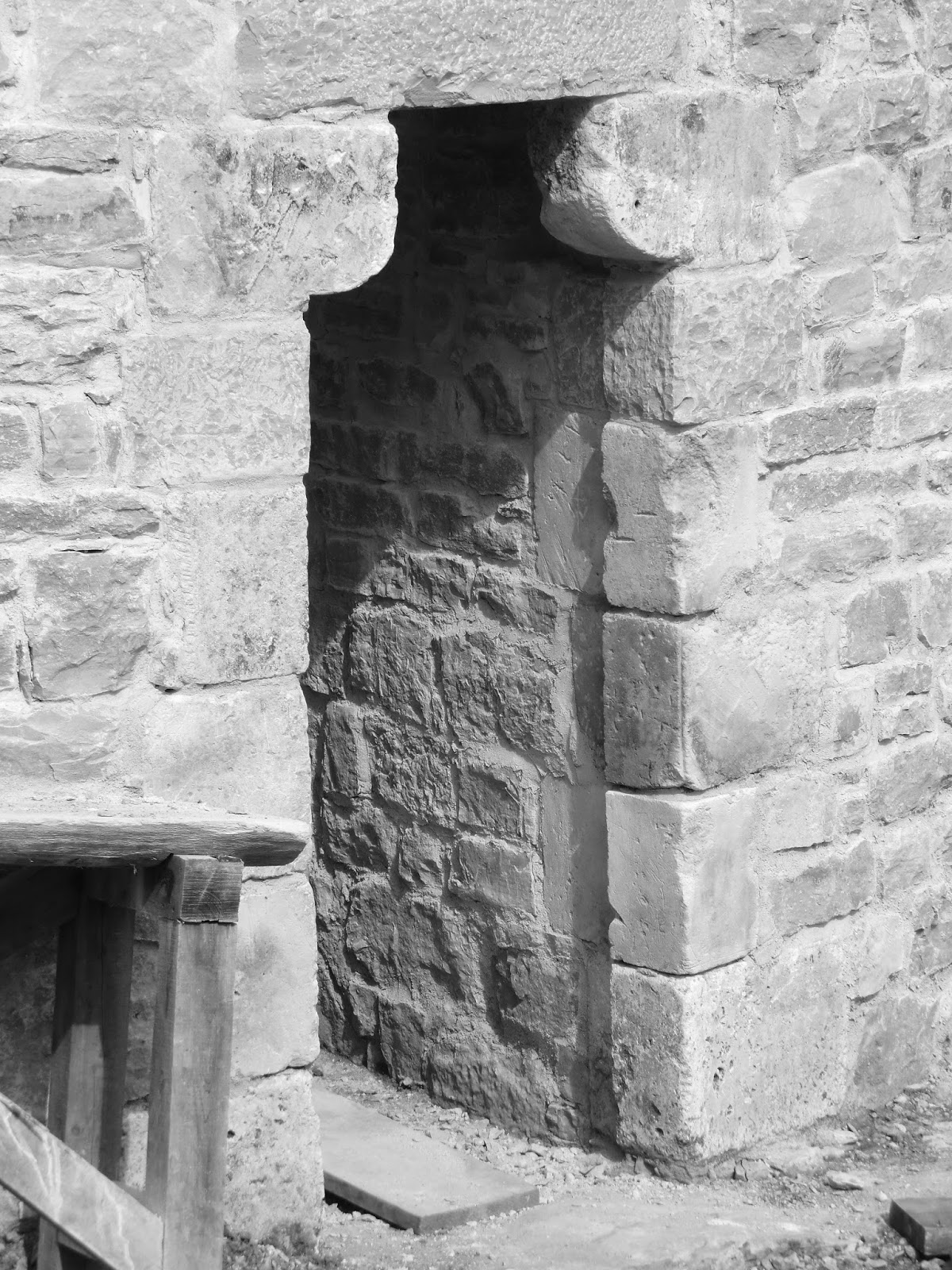 |
| A tower doorway at OMF |
Why did they pick Arkansas, of all places? Convenience. They touted on their website that the landscape was very similar to that of Southern France, and also happened to have a limestone quarry, which is essential to the castle building, and it was even conveniently only 30 miles south of the touristy Branson, MO. Branson would be a great location for an attraction directed at seniors or families with small children, but Branson, and the entire Midwest is not exactly a place known for its interest in European History. The castle was not at all handicapped accessible and was not exactly a safe environment to encourage young children to run about. These conditions essentially exclude 80-90% of all of Branson's typical visitors.
So what might have been a better location? Somewhere with beautiful scenery that could be compared to somewhere in Europe, but somewhere with a larger population nearby, somewhere that attracts international visitors, and somewhere with a population more inclined to be interested in European history enough to want to visit a Medieval European Style Castle-in-Progress. Good candidates might include locations in Colorado, California, Washington State, Florida, or upstate New York.
3. Don't Translate Your Written Materials Directly from French. Or Any Other Language.
The relationship of the Chateau de Guedelon with the Ozark Medieval Fortress was something akin to a big brother - little sister type of relationship, with much of the information and planning for the OMF coming directly from the French project. This is helpful in that the instructions on masonry and signage come from experts, but this arrangement also caused some problems in translation. Foremost among these was the press release given to news media throughout America to announce the opening of the Ozark Medieval Fortress. Somehow, the facts got mixed up so that the release bragged that the Ozark Medieval Fortress would be "a genuine, full-sized, fortified castle, with 24-foot high towers, a drawbridge, and 6-foot wide stone walls." That sounds rather unimpressive, and not like a full-sized castle, or anything worth visiting. In reality, the walls were 6 feet thick and 24 feet tall, and the tallest of the towers was planned to be over 70 feet tall.
Other instances of translated material not turning out so well was in the signage scattered throughout the castle site. Several had typos or were worded awkwardly, but one in particular explained the "wise witch." This title is perfectly innocuous in France, but in America, the word "witch" has certain very negative connotations. A better English translation would be something like "wise woman" - the village expert on herbs and remedies.
These problems could have all been avoided by assuring that a native English speaker wrote and/or translates all of the written material associated with the Ozark Medieval Fortress.

What is an "Ozark Medieval Fortress" anyway? Some people don't even know what "medieval" means, but they're sure going to know what a castle is. "Fortress" brings to mind a civil war fort or other military construction, and not necessarily a castle. Even the word "Ozark" carries a certain stigma with it. The castle could have been named just about anything other than "Ozark Medieval Fortress," as long as "castle" or "chateau" was in the name.
On the castle's website and in their one advertising campaign, the motto was,
"They're building it. Come see it!"
The point of a motto is to stick in peoples' minds and convince them to visit the castle, but I think they could have come up with something far better.
I think the castle's advertising would have been far more effective if the question of "who would want to visit a castle construction site in America?" had been longer considered. They might have chosen a better geographic location, and might have realized that their best target audiences would probably have been students and academics, as well as fans of historical reenacting and fantasy genres.
1. Don't Run a History-Based Attraction Without an Expert Advisor on Board.
Though the project certainly had many staff and volunteers who were well versed in the restoring and building of castles, and even some who were quite familiar with reenacting, it seems that for the most part, there were no true experts involved in the oversight of the Ozark Medieval Fortress. From what I can find, the main tour guide at the castle (who also served as its official historian) had a Bachelor's degree in European History and had attended a summer program on the Middle Ages in Germany. He certainly was very knowledgeable on the Middle Ages, but such credentials hardly compare to someone with a Master's or PhD in Medieval Studies or Medieval History. And no such expert was to be found on the Ozark Medieval Fortress Team. Other good candidates might have been an archaeologist who specialized in medieval sites, an experimental archaeologist, or a historical architect.
If they had held such an expert on staff or even just as an advisor, perhaps the whole project would have turned out differently.
A few news articles have covered the closing of the Ozark Medieval Fortress, including the New York Times, but for the most part it has unfortunately gone unnoticed. I would love to see someone pick up the unfinished castle and breathe new life into it, and I think it could be salvaged. But whether someone buys and revitalizes the Ozark Medieval Fortress, or starts a new project somewhere else, I hope they won't repeat the same mistakes.
Disclaimer: Some of this information has been very difficult to research, since the Ozark Medieval Fortress website is gone. I might have missed some important information, and I really want this to be an informed and accurate blog, so if you know of any information that I missed that might change what I said, or if I got something wrong, please let me know. I wrote this article to show how we can use the Ozark Medieval Fortress as an example and learn from its problems, so that the next time a project like this is begun in America (or anywhere else), it might have a greater chance at success.


