Showing posts with label Anglo-Saxons. Show all posts
Thursday, January 22, 2015
Se Gere Twegen Þúsend ond Fiften
Or, se gere twegen þúsend ond fiften, as the Anglo-Saxons might have said it.
I don't personally believe in new years resolutions, per se, but I do think that a calendar year can be a useful tool for setting goals for growth and change. 2014 was a year of many big changes for me: I graduated from college, and I married a wonderful man in August (more about that in a later post). As soon as classes ended in May, my life was consumed with wedding planning, and though that kind of craziness changed into a different kind after the wedding (in a good way), things have settled down just enough that I can spend a little bit of time on blogging again. (Yay!)
So what are my goals for 2015? Good question. I want this to be the year in which I take Badon Hill (my creative business) from the I-sell-on-Etsy.com/part-time/hobby level to the I-own-a-small-business level. This is huge. Reaching my goals will require many, many changes, and has already been very challenging, and I have a long way yet to go. This also means that there are some changes in store for this blog; I haven't completely fleshed those out yet, but I know you can expect more tutorials and more about my handmade ventures, as well as the usual historical-fun.
So here is a peek at some of my goals for 2015:
➵ Develop and stick with a consistent blogging schedule.
➵ Transition Badon Hill primarily to an independent website.
➵ Have an area of my home set up as my dedicated studio space.
➵ Pitch and complete at least 6 wholesale orders.
➵ Always be reading a new book.
There are a few other goals, but those are the big ones. Follow along with me through the year, as I post updates on how I'm doing with these goals (among lots of other new content)! What goals do you have for 2015?
Tuesday, May 20, 2014
Wyruld-Cyninga (I'm a Double BA!)
I graduated from college!
I finished Bachelors of Arts degrees in both Medieval Studies and English (British Literature), with a minor in Art History (because I'm not hardcore enough for the Art History major - seriously, it's a super tough major at Truman). To celebrate this achievement, I decided to paint an applicable portion of the Old English epic, Beowulf, onto my graduation cap. I chose Beowulf because it not only represents my English degree, but also the Northern European focus of my Medieval Studies degree, plus, I had just finished a course where we spent the entire semester translating the 3182-line poem from the original Anglo-Saxon. What I didn't expect, was that this project would take about 10 hours, keeping me up until 3 A.M. on the morning of my graduation.
I chose the very last sentence of the poem, its last three lines:
cwæðon þæt he wære wyruld-cyninga,
manna mildust ond mon-ðwærust,
leodum liðost ond loft-geornost.
They said that of all the kings in the world,
of men he [Beowulf] was the mildest and most beloved,
to his kin the kindest, and most eager for praise.
I painted these lines, and several preceding lines, on my cap based on a high resolution scan of the original manuscript page, available for free online, published by the British Library. This part of the Nowell Codex (the manuscript in which Beowulf covers folios 132r - 201v, dated to roughly 1000 AD) is heavily damaged, but it was still incredibly valuable and fascinating to get to work with a scan of the actual manuscript so that my finished product might be a more accurate representation of the original. For instance, the manuscript is not divided into metered lines, as in most translations and transcriptions, so I reflected this aspect with my painting. The orthography is also significantly different from Modern English.
This sentence gives a good picture into the contemporary culture of Anglo-Saxon England, especially with the phrase "most eager for praise." Today, living with the goal of earning other people's praise may sound self-righteous or arrogant, but in a highly community-focused culture (such as Beowulf's) where reputation was everything, it makes perfect sense. In general, decent people will praise that which is decent and good, so by being "most eager for praise," Beowulf would have been striving to live honorably and nobly.
This sentence means a lot to me because it is not only a highly honoring eulogy for the legendary monster and dragon-slaying king, Beowulf son of Ecgtheow, but it is also a standard worth striving for even today. Though the poem was not a Christian poem, this sentence exudes qualities I want to display in my own life. I strive to live such that the love that Christ showed to me by paying a debt I owed but could never pay would overflow from me in the form of a love and kindness for all people. I can't earn this redemption, but I want to glorify God with my life, thereby living such that I'll earn His praise and one day He'll say to me "well done, my good and faithful servant."
I finished Bachelors of Arts degrees in both Medieval Studies and English (British Literature), with a minor in Art History (because I'm not hardcore enough for the Art History major - seriously, it's a super tough major at Truman). To celebrate this achievement, I decided to paint an applicable portion of the Old English epic, Beowulf, onto my graduation cap. I chose Beowulf because it not only represents my English degree, but also the Northern European focus of my Medieval Studies degree, plus, I had just finished a course where we spent the entire semester translating the 3182-line poem from the original Anglo-Saxon. What I didn't expect, was that this project would take about 10 hours, keeping me up until 3 A.M. on the morning of my graduation.
I chose the very last sentence of the poem, its last three lines:
cwæðon þæt he wære wyruld-cyninga,
manna mildust ond mon-ðwærust,
leodum liðost ond loft-geornost.
They said that of all the kings in the world,
of men he [Beowulf] was the mildest and most beloved,
to his kin the kindest, and most eager for praise.
I painted these lines, and several preceding lines, on my cap based on a high resolution scan of the original manuscript page, available for free online, published by the British Library. This part of the Nowell Codex (the manuscript in which Beowulf covers folios 132r - 201v, dated to roughly 1000 AD) is heavily damaged, but it was still incredibly valuable and fascinating to get to work with a scan of the actual manuscript so that my finished product might be a more accurate representation of the original. For instance, the manuscript is not divided into metered lines, as in most translations and transcriptions, so I reflected this aspect with my painting. The orthography is also significantly different from Modern English.
This sentence gives a good picture into the contemporary culture of Anglo-Saxon England, especially with the phrase "most eager for praise." Today, living with the goal of earning other people's praise may sound self-righteous or arrogant, but in a highly community-focused culture (such as Beowulf's) where reputation was everything, it makes perfect sense. In general, decent people will praise that which is decent and good, so by being "most eager for praise," Beowulf would have been striving to live honorably and nobly.
This sentence means a lot to me because it is not only a highly honoring eulogy for the legendary monster and dragon-slaying king, Beowulf son of Ecgtheow, but it is also a standard worth striving for even today. Though the poem was not a Christian poem, this sentence exudes qualities I want to display in my own life. I strive to live such that the love that Christ showed to me by paying a debt I owed but could never pay would overflow from me in the form of a love and kindness for all people. I can't earn this redemption, but I want to glorify God with my life, thereby living such that I'll earn His praise and one day He'll say to me "well done, my good and faithful servant."
Saturday, March 1, 2014
Anglo-Saxon Saturdays: Wulfes-Heafod
This Thursday, the History Channel series, Vikings, opened Season 2 with an episode called "Brother's War." Aside from the fantastic Viking shield-wall battle, gorgeous scenery, and imaginative costumes, the episode dealt boldly with the issue of betrayal. Without giving too much away, I thought it strange that when the traitor came to trial in this episode, the punishment everyone expected to be carried out was death. Death is certainly a terrible punishment, and probably fitting for such a grievous betrayal, but I had expected the verdict would be the Germanic institution of wulfes-heafod.
wulfes-heafod
(wolf-es heh-av-od)
Wulfes-heafod translates literally to "wolf's head," and no, this is not a mythic creature or monster, some sort of human with a wolf's head. Wolf's-head was a severe punishment for severe crime. When someone committed a crime serious enough to warrant a verdict of wulfes-heafod, such as murder or betrayal of one's lord, a priest (or other leader) would place his hand on the convicted criminal and declare him a wolf's-head.
Last week, I talked about Anglo-Saxon agoraphobia and how they did not like open places, but instead felt secure under a roof - both a literal one and the figurative roof of societal laws. This is exactly why being declared wolf's-head was such a terrible punishment; a wolf's-head was declared to be a wolf.
If you were declared a wulfes-heafod, you were no longer considered human. You were an "outlaw," that is, you were no longer under the protection of the law. No one was allowed to acknowledge you as a person; they couldn't talk to you, or give you food or shelter. Worst of all, they could, and were almost obligated to, kill you. Wolves were a threat, they were pests who attacked livestock and sometimes people, so whenever a wolf was spotted, it would be hunted. The same idea was supposed to apply to a wolf's-head, if seen, he would be hunted.
This, alone, would be a horrible fate for anyone at any period in history, but it was especially terrible for Anglo-Saxons (and in other Germanic cultures, such as in Vikings) because of their agoraphobia, their fear of open spaces. Being declared a wulfes-heafod exiled you only to open spaces, and away from the protection of the law. Being an "outlaw" was not freedom, it was a punishment worse than death.
wulfes-heafod
(wolf-es heh-av-od)
![]() |
| a wolf-headed creature in the 15th c. Nuremberg Chronicle |
Last week, I talked about Anglo-Saxon agoraphobia and how they did not like open places, but instead felt secure under a roof - both a literal one and the figurative roof of societal laws. This is exactly why being declared wolf's-head was such a terrible punishment; a wolf's-head was declared to be a wolf.
If you were declared a wulfes-heafod, you were no longer considered human. You were an "outlaw," that is, you were no longer under the protection of the law. No one was allowed to acknowledge you as a person; they couldn't talk to you, or give you food or shelter. Worst of all, they could, and were almost obligated to, kill you. Wolves were a threat, they were pests who attacked livestock and sometimes people, so whenever a wolf was spotted, it would be hunted. The same idea was supposed to apply to a wolf's-head, if seen, he would be hunted.
This, alone, would be a horrible fate for anyone at any period in history, but it was especially terrible for Anglo-Saxons (and in other Germanic cultures, such as in Vikings) because of their agoraphobia, their fear of open spaces. Being declared a wulfes-heafod exiled you only to open spaces, and away from the protection of the law. Being an "outlaw" was not freedom, it was a punishment worse than death.
Saturday, February 22, 2014
Anglo-Saxon Saturdays: Weox Under Wolcnum
Last time, I wrote about one way in which the Anglo-Saxon conception of the world is different from ours in Modern America. This week, I'd like to share another, and this one is also illustrated with the help of a phrase from the proem to Beowulf:
Weox under wolcnum
(way-ox oon-der wohlk-num)
This phrase is the first half of line 8 in Beowulf and refers to the legendary king, Scyld Scefing, as he grew into a man. Weox under wolcnum translates to "waxed under welkin" or with more familiar vocabulary, "grew under the heavens." The poet chose the word "wolcnum" to fit the alliteration* but the concept, not the particular word, is what is important here. The idea is that Scyld grew up under the protection of the heavens, under the safety of the skies. This is a sort of verbal fencing-in, giving the impression of a sheep fold or fenced pasture that was a safe and happy place in which to grow up.
The Anglo-Saxons were an agoraphobic people. They saw rules and boundaries and a roof over the head as safe and protective. This plays into how community-oriented the Anglo-Saxon culture was as well. They were closely tied with their local communities and the idea of leaving those ties was terrifying (as I will expand upon in the next Anglo-Saxon Saturdays post, wulfes heafod). The happiest scenes in Anglo-Saxon literature fall under the theme of "joys of the hall" or the eating and drinking and singing and boasting and general merriment that went on in the safety of an Anglo-Saxon mead-hall.
When Grendel comes to attack Heorot in Beowulf, he comes from the wilderness, from the fens. This is where monsters and dragons dwell and you don't have the protection of your fences or home or your fighting companions anymore. The laws of man and common decency do not apply there, and the wild is a dangerous place where the weather, the landscape, and the animals seem to conspire together for your destruction.
This is the exact opposite of how most modern Americans feel. Our culture is claustrophobic. We tend to see boundaries and walls as confining, as something to be challenged. We tend to see wide open spaces as places of freedom and adventure, where anything is possible (think of the genre of American Westerns). But this is exactly what scared Anglo-Saxons about open spaces: if anything can happen, then anything can go wrong.
*Alliteration is a convention of Anglo-Saxon poetry; rather than rhyme, in which words sound alike at the end (i.e. - walker, knocker, sock her), when words alliterate, they sound alike at the beginning (i.e. - Will would wish to wail?).
Weox under wolcnum
(way-ox oon-der wohlk-num)
This phrase is the first half of line 8 in Beowulf and refers to the legendary king, Scyld Scefing, as he grew into a man. Weox under wolcnum translates to "waxed under welkin" or with more familiar vocabulary, "grew under the heavens." The poet chose the word "wolcnum" to fit the alliteration* but the concept, not the particular word, is what is important here. The idea is that Scyld grew up under the protection of the heavens, under the safety of the skies. This is a sort of verbal fencing-in, giving the impression of a sheep fold or fenced pasture that was a safe and happy place in which to grow up.
The Anglo-Saxons were an agoraphobic people. They saw rules and boundaries and a roof over the head as safe and protective. This plays into how community-oriented the Anglo-Saxon culture was as well. They were closely tied with their local communities and the idea of leaving those ties was terrifying (as I will expand upon in the next Anglo-Saxon Saturdays post, wulfes heafod). The happiest scenes in Anglo-Saxon literature fall under the theme of "joys of the hall" or the eating and drinking and singing and boasting and general merriment that went on in the safety of an Anglo-Saxon mead-hall.
When Grendel comes to attack Heorot in Beowulf, he comes from the wilderness, from the fens. This is where monsters and dragons dwell and you don't have the protection of your fences or home or your fighting companions anymore. The laws of man and common decency do not apply there, and the wild is a dangerous place where the weather, the landscape, and the animals seem to conspire together for your destruction.
This is the exact opposite of how most modern Americans feel. Our culture is claustrophobic. We tend to see boundaries and walls as confining, as something to be challenged. We tend to see wide open spaces as places of freedom and adventure, where anything is possible (think of the genre of American Westerns). But this is exactly what scared Anglo-Saxons about open spaces: if anything can happen, then anything can go wrong.
*Alliteration is a convention of Anglo-Saxon poetry; rather than rhyme, in which words sound alike at the end (i.e. - walker, knocker, sock her), when words alliterate, they sound alike at the beginning (i.e. - Will would wish to wail?).
Saturday, January 25, 2014
Anglo-Saxon Saturdays: Þrym
The Anglo-Saxon culture of early medieval England seems in some ways very familiar to us today, but in many other ways their culture was vastly different. For example, their conception of emotion was as an action, rather than a state of being. So they would express the emotion of anger as "I anger," rather than how we would express it in Modern English as "I am angry." This week's word from the Anglo-Saxon lexicon illustrates another way in which the Anglo-Saxons conceived of something differently than we do:
Þrym
(Thrumm)
The first sentence of Beowulf, in lines 1-3, reads like this:
HWÆT, WE GAR-DEna in geardagum,
þeodcyninga þrym gefrunon,
hu ða æþelingas ellen fremedon!
(Lo! We of the Spear-Danes, in days of yore
of the people's kings, the glory heard,
how the noble ones framed courage!)
This sentence sets the backdrop for the rest of the poem, starting with the story of the great Scyld Scefing, legendary leader of the Spear-Danes, as an example of a god cyning (good king). The word þrym, in the second line, translated here as "glory" carries a lot more meaning that just that. Þrym can also mean noise, sound, strength, power, majesty, and reputation. The last of these is the most telling, as the idea of "reputation" and noise typically do not go together in the modern reader's mind.
The Anglo-Saxon conception of reputation and glory was very different from ours today. Today, we tend to conceptualize "glory" visually, represented by bright light, often seen as a sunrise, halo, or a sort of glowing aura. (Try googling "glory" and you'll see what I mean.) The Anglo-Saxons, however, thought of glory as an audible phenomenon, thus, reputation and glory and noise could all be embedded in the same word. This has a lot to do with the Anglo-Saxon's warrior-ethos culture and the high value on boasting, storytelling, and reputation.
The Anglo-Saxons had a pre-individualist culture, meaning that in their culture, individuals placed their own needs below those of their community. Leaving your community was not really an option, and since you couldn't get away from the people you lived and worked with, their opinion of you was extremely important. The way to keep up your reputation was to act such that people spoke highly of you, that you could boast about your accomplishments publicly, and that people would continue to talk and sing about you even after you were gone.
So the idea of noise and reputation and majesty all being included in one word, þrym, helps us to understand a little bit more about the Anglo-Saxons; the more noise there was about you (the more people talked about you), the more power you had, the higher your reputation, and the more respected you would be in your community.
Selected Sources:
Beowulf: A Glossed Text, edited by Michael Alexander, Penguin Books, 1995.
A Compendious Anglo-Saxon and English Dictionary, by Rev. Joseph Bosworth, Forgotten Books 2012, Originally Published 1848.
![]() |
| The first page of Beowulf in the Nowell Codex |
(Thrumm)
The first sentence of Beowulf, in lines 1-3, reads like this:
HWÆT, WE GAR-DEna in geardagum,
þeodcyninga þrym gefrunon,
hu ða æþelingas ellen fremedon!
(Lo! We of the Spear-Danes, in days of yore
of the people's kings, the glory heard,
how the noble ones framed courage!)
This sentence sets the backdrop for the rest of the poem, starting with the story of the great Scyld Scefing, legendary leader of the Spear-Danes, as an example of a god cyning (good king). The word þrym, in the second line, translated here as "glory" carries a lot more meaning that just that. Þrym can also mean noise, sound, strength, power, majesty, and reputation. The last of these is the most telling, as the idea of "reputation" and noise typically do not go together in the modern reader's mind.
The Anglo-Saxon conception of reputation and glory was very different from ours today. Today, we tend to conceptualize "glory" visually, represented by bright light, often seen as a sunrise, halo, or a sort of glowing aura. (Try googling "glory" and you'll see what I mean.) The Anglo-Saxons, however, thought of glory as an audible phenomenon, thus, reputation and glory and noise could all be embedded in the same word. This has a lot to do with the Anglo-Saxon's warrior-ethos culture and the high value on boasting, storytelling, and reputation.
The Anglo-Saxons had a pre-individualist culture, meaning that in their culture, individuals placed their own needs below those of their community. Leaving your community was not really an option, and since you couldn't get away from the people you lived and worked with, their opinion of you was extremely important. The way to keep up your reputation was to act such that people spoke highly of you, that you could boast about your accomplishments publicly, and that people would continue to talk and sing about you even after you were gone.
So the idea of noise and reputation and majesty all being included in one word, þrym, helps us to understand a little bit more about the Anglo-Saxons; the more noise there was about you (the more people talked about you), the more power you had, the higher your reputation, and the more respected you would be in your community.
Selected Sources:
Beowulf: A Glossed Text, edited by Michael Alexander, Penguin Books, 1995.
A Compendious Anglo-Saxon and English Dictionary, by Rev. Joseph Bosworth, Forgotten Books 2012, Originally Published 1848.
Saturday, December 28, 2013
Anglo-Saxon Saturdays: Geol
In my previous post, I introduced my new series on the Anglo-Saxon world of England in the Early Middle Ages by discussing the word hwæt and what it can tell us about the nature of the Anglo-Saxon oral storytelling culture. This week, I'd like to share about the word:
Geol
Yay-ol ("ol" like in "bowl")
The word geol (sometimes spelled geohol) comes from the word gal, which meant "light" or "merry," and it once refered to the two midwinter months of December and January. This time was filled with various feasts and festivals celebrated by the Pre-Christian Anglo-Saxons. For example, December 25 was called Modranect (Mother's Night) and was celebrated as the beginning of the new year. Many of these festivals had to do with fertility (in winter, a time of infertility) and the Germanic god and goddess twins Freyr and Freyja may have been involved.
Once Christianity dominated the culture and Christmas replaced the pagan winter holidays by the 7th century AD, geol's meaning narrowed to reference the 12-day Feast of the Nativity, which began the day after Christmas Day (December 25) and ended on January 6, Epiphany, or the day when the coming of the Magi was celebrated. Later, use of the word geol narrowed even further to simply refer to Christmas Day, and was eventually replaced by the word "Christmas" itself. (Later on, the German version of the word, Yuletide, was imported into English again and still refers to the midwinter and/or Christmas season today.)
As a side note, there is no evidence that the Yule log tradition was celebrated in Anglo-Saxon England, though historian Henry Bourne theorized such. It is more likely that this particular Christmas-time tradition was imported to England in the Early Modern period, from the Germanic area of mainland Europe.
God Geol! (Good Yule!)
Selected Sources:
A Compendious Anglo-Saxon and English Dictionary, by Rev. Joseph Bosworth, Forgotten Books 2012, Originally Published 1848.
"Yule (n.)," Online Etymology Dictonary.
Geol
Yay-ol ("ol" like in "bowl")
The word geol (sometimes spelled geohol) comes from the word gal, which meant "light" or "merry," and it once refered to the two midwinter months of December and January. This time was filled with various feasts and festivals celebrated by the Pre-Christian Anglo-Saxons. For example, December 25 was called Modranect (Mother's Night) and was celebrated as the beginning of the new year. Many of these festivals had to do with fertility (in winter, a time of infertility) and the Germanic god and goddess twins Freyr and Freyja may have been involved.
Once Christianity dominated the culture and Christmas replaced the pagan winter holidays by the 7th century AD, geol's meaning narrowed to reference the 12-day Feast of the Nativity, which began the day after Christmas Day (December 25) and ended on January 6, Epiphany, or the day when the coming of the Magi was celebrated. Later, use of the word geol narrowed even further to simply refer to Christmas Day, and was eventually replaced by the word "Christmas" itself. (Later on, the German version of the word, Yuletide, was imported into English again and still refers to the midwinter and/or Christmas season today.)
As a side note, there is no evidence that the Yule log tradition was celebrated in Anglo-Saxon England, though historian Henry Bourne theorized such. It is more likely that this particular Christmas-time tradition was imported to England in the Early Modern period, from the Germanic area of mainland Europe.
God Geol! (Good Yule!)
Selected Sources:
A Compendious Anglo-Saxon and English Dictionary, by Rev. Joseph Bosworth, Forgotten Books 2012, Originally Published 1848.
"Yule (n.)," Online Etymology Dictonary.
Sunday, December 22, 2013
Anglo-Saxon Saturdays: Hwæt!
I'm starting a new series! There's a medieval culture and society that was extremely influential on modern speakers of the English language, and on Western Civilization in general: the Anglo-Saxons. These were the rulers and dwellers of Angle-Land (England) throughout the first half of the middle ages, and they spoke a language called Anglo-Saxon, also known as Old English.* So in this series, I'll share little tidbits of interesting slices of Anglo-Saxon culture, often illustrated and centered around a particular word from the Anglo-Saxon language.
And the first word is....
Hwæt!
Hwhat, ("a" like in "pat")
This word is probably best known as the first word of the Anglo-Saxon epic, Beowulf. It is often translated as "Lo!" or "Hear!" or something of that nature, but a direct translation into Modern English is really rather impossible. The term carries more meaning than a single MnE** word could convey, though Lo! Is probably the closest, albeit most archaic, possibility.
Hwæt! was a typical opening for a long story-poem such as Beowulf in Anglo-Saxon culture. It was the poet-performer's way of signaling to his audience, "Hey! Listen up! I'm about to tell a story in an authoritative voice that's not my own!" Meaning that the performer had the authority, or experience and knowledge, to tell the following story and he was not speaking in his own, everyday voice, but the voice of poetic and historical authority.
This is a good example of the Composition-in-Performance nature of Anglo-Saxon poetry that is almost completely foreign to the modern reader. This means that the extant versions of poems such as Beowulf that we have in written form were merely one version of a story that would have changed a little bit (or possibly a lot) each time it was retold. They were not memorized word-for-word, but instead the poet-performer (called a scop in Old English) would use the known story as a sort of roadmap or guide for his story, and add in details, stock filler phrases, and references to other stories or characters from his extensive repertoire to complete the alliterative scheme or meter, and show off his skill and knowledge.
The Anglo-Saxon culture had many facets and many fascinating stories to tell, so check back again next Saturday for the next peek into their rich literary and societal legacy!
*"Old English" is not the language of Shakespeare. Believe it or not, that version of English is actually called Early Modern English, and the language of Chaucer was the intermediate between Modern and Old English, aptly named, Middle English (which was an unparalled hybridization of Norman-French and Old English).
**MnE is an abbreviation for "Modern English."
And the first word is....
Hwæt!
Hwhat, ("a" like in "pat")
This word is probably best known as the first word of the Anglo-Saxon epic, Beowulf. It is often translated as "Lo!" or "Hear!" or something of that nature, but a direct translation into Modern English is really rather impossible. The term carries more meaning than a single MnE** word could convey, though Lo! Is probably the closest, albeit most archaic, possibility.
Hwæt! was a typical opening for a long story-poem such as Beowulf in Anglo-Saxon culture. It was the poet-performer's way of signaling to his audience, "Hey! Listen up! I'm about to tell a story in an authoritative voice that's not my own!" Meaning that the performer had the authority, or experience and knowledge, to tell the following story and he was not speaking in his own, everyday voice, but the voice of poetic and historical authority.
This is a good example of the Composition-in-Performance nature of Anglo-Saxon poetry that is almost completely foreign to the modern reader. This means that the extant versions of poems such as Beowulf that we have in written form were merely one version of a story that would have changed a little bit (or possibly a lot) each time it was retold. They were not memorized word-for-word, but instead the poet-performer (called a scop in Old English) would use the known story as a sort of roadmap or guide for his story, and add in details, stock filler phrases, and references to other stories or characters from his extensive repertoire to complete the alliterative scheme or meter, and show off his skill and knowledge.
The Anglo-Saxon culture had many facets and many fascinating stories to tell, so check back again next Saturday for the next peek into their rich literary and societal legacy!
*"Old English" is not the language of Shakespeare. Believe it or not, that version of English is actually called Early Modern English, and the language of Chaucer was the intermediate between Modern and Old English, aptly named, Middle English (which was an unparalled hybridization of Norman-French and Old English).
**MnE is an abbreviation for "Modern English."
Tuesday, July 31, 2012
Harold: Last King of the Anglo-Saxons
A Tale of Two Battles: Harold Godwinsson (or Godwin, or Godwinson) was crowned King of England in January, 1066, as per the wishes of King Edward the Confessor and the Witan (the high council of noblemen, responsible for choosing the next king). Harold was expecting William to invade, as William believed he had been promised the English crown decades before,[2] so in early May, Harold summoned one of the largest armies England had ever seen.[3] He also called the English fleet to patrol the English Channel, waiting to fight off the expected Norman invasion fleet. But foul weather and politics kept William from sailing over the Channel, and provisions and pay ran dry by early September, so Harold dissolved the fyrd (the national army) and told the fleet to return to port.[4] Military campaigns were rare in the cold winter, so it was reasonable to assume that if William had not yet made his move, he would wait until spring.
On September 12, however, the weather changed and allowed William of Normandy to set out for England. The Normans happened to run into the English armada and a sea-battle ensued, only to be cut short by a storm. Because of the Normans' inferior ships, they suffered great losses.[5] While Harold was at the London docks hearing of the sea battle with the Normans, a messenger arrived to warn the king that Tostig, Harold's envious and revengeful brother, had convinced King Harald Hardraada of Norway to invade England in the north.[6] Harold and his housecarls (personal guards/soldiers) immediately marched north, calling his fyrd to be gathered after him.[7]
![]() |
| A 19th century Norwegian depiction of the battle |
The victory celebrations lasted six days, until a messenger brought the news that William of Normandy had landed and was devastating the land around Pevensey, in southern England.[11] Harold had 241 miles to march to meet the invaders, and Harold covered the distance averaging an incredible speed of over forty miles a day.[12] Harold’s fyrd had suffered heavy losses at Stamford Bridge, so he called for a mass levy of every man able to fight.[13] The reinforcements which arrived in time to leave London with Harold on October 12 totaled over 4,000. More men joined Harold’s troops as they marched south toward Hastings, so that by the time the battle began on October 14, Harold’s troops numbered around 8,500.[14]
The core of Harold’s fyrd, the housecarls, had taken heavy casualties at Stamford Bridge, leaving Harold with no option to employ a mounted regiment, as had been so successful at Stamford Bridge.[15] Instead, the housecarls would serve as the regulating backbone of his levied army – the majority of which were now inexperienced men mostly lacking armor and armed with primitive weapons such as hayforks and clubs.[16]
The Battle of Hastings began in the late
morning, with Harold’s troops forming a strong battle line atop a ridge,
forcing the Normans to charge up the hill to attack them.[17]
Had all of Harold’s men been trained and experienced soldiers, the plan
probably would have worked. But by late afternoon, both forces had taken heavy
losses, and after one attack, the Norman cavalry turned and fled in retreat.
The shire-levies (the untrained men called by the mass levy) broke from the
line and pursued the fleeing Normans, battle-eager and “unaware of the danger
they brought upon themselves and the whole hope of England.”[18]
The retreating Normans turned around and enveloped the separated Englishmen,
few of whom survived to regain the ridge. Harold had the fyrd regroup into a
tight clump around his standard at the crest of the hill, but a group of
Normans fought straight for the king of England and killed him.[19]
Once word of the king’s death had spread among the remaining troops, they began
to flee the battlefield. A small detachment of the English made a last stand
against Norman pursuers by luring them to charge (to their deaths) over a ravine in the dim
twilight, but the battle – and England – was lost.[20]
Speeches, Strategy, and Stirrups: Remember how I said that scholars have blamed things such as inferior military technology and poor leadership for the downfall of the English at Hastings? Well, I don't believe that either of those were the real reason behind the English defeat. For one thing, the Anglo-Saxon chroniclers are adamantly clear that King Harold was an exceptional military leader and motivator. He was known to give eloquent and rousing speeches,[21] and was unparalleled in his ability to move his troops at astonishing speeds while marching northward to Stamford Bridge, then south to Hastings.[22]
I even remember reading somewhere that the Normans won because they had the technology of the stirrup (which was relatively new in Europe in 1066), allowing the Norman knights to fight effectively atop horses, while the Anglo-Saxons did not have the stirrup and therefore only fought on foot (wrong, they did have stirrups). I've also read that the Anglo-Saxons did not know how to fight on horseback, though they did have stirrups - they would ride to a battle, then dismount and fight on foot. This was actually true for most of Anglo-Saxon history, but we know that Harold employed mounted warriors very effectively at the Battle of Stamford Bridge. He lost far too many horses, however, to employ similar strategy at Hastings.
And that's where Harold's strategy comes into play. Harold had proven himself an excellent warrior and military leader long before his coronation, fighting in a series of campaigns in Wales. The chronicler Orderic Vitalis described Harold as "very tall and handsome, remarkable for his physical strength, his courage and eloquence, his ready jests and acts of valor."
The Real Culprit: Fatigue. Most medieval battles lasted around an hour or
two, ending with one side causing the other to flee the battlefield, so the descriptions
of the Battle of Stamford Bridge lasting all day, and the Battle of Hastings
lasting about nine hours combine for two very long and exhausting battles.[23] In addition to the fighting itself, Harold and
his fyrd marched day and night for several days and then immediately begin
attacking the army of Harald Hardraada upon arrival. Similarly, the march
southward to London and then Hastings was also an incredible feat, as the
English fyrd traveled over forty miles a day – a
challenging pace even for soldiers who were mounted, and soldiers with horses
accounted for less than half of Harold’s army.
According to the U.S. Army Medical Department, “Fatigue
adversely affects a person’s framework; emotional, cognitive, physical, social,
and spiritual aspects are compromised.”[24] In addition to travel, chronicles tell of
singing, dancing, and drinking that filled the night for the men of the fyrd.
Denis Butler writes that it was likely the inexperienced new soldiers whose
unthinking excitement led them to party through the night, while the veterans
of Stamford Bridge and other experienced soldiers likely tried to rest while
they could.[25]
Drinking, dancing, and singing through the night certainly would have started
those already disadvantaged soldiers – because of their lack of experience,
armor, or decent weapons – at a greater disadvantage because of a lack of sleep
and the exertion of the night’s merriment.
In the End, the battle that changed the course of English
history was lost for the English not because of poor leadership, technology, or lack of
military expertise, but because of a series of circumstances far outside of
Harold Godwinsson’s control. Certainly, other factors contributed to Harold’s
demise and that of England, but the result of the compressed timing of the
Battles of Stamford Bridge and Hastings was unavoidable fatigue. Though
Harold’s leadership fought valiantly against the effects of the fatigue with
his ability to move and motivate his troops, fatigue won out in the end and
England succumbed to the Norman invasion of 1066. William pressed an unwilling Anglo-Saxon England into the Frankish-European world, and the glory of Anglo-Saxon England, along with her last king, Harold Godwinsson, breathed their last.
[1]
Denis Butler, 1066: The Story of a Year, (New York: G. P. Putnam’s Sons, 1966), 27. [2] Emma Mason, The House of Godwine, (New York: Hambledon and London, 2004), 141-142. [3] Emma Mason, 143. [4] Denis Butler, 162. [5] Denis Butler, 169. [6] Denis Butler, 194. [7] Denis Butler, 169-170. [8] Denis Butler, 184. [9] Kelly DeVries, The Norwegian Invasion of England in 1066, (Woodbridge, UK: The Boydell Press, 1999), 278-279. [10] Kelly DeVries, 295. [11] Denis Butler, 203. [12] Denis Butler, 205, 210. [13] Denis Butler, 205. [14] Denis Butler, 217-220. [15] Emma Mason, 163. [16] Denis Butler, 229. [17] Edwin Tetlow, The Enigma of Hastings, (New York: St. Martin’s Press, 1974), 171. [18] Denis Butler, 243-244. [19] Denis Butler 248-249. [20] Denis Butler, 250-251. [21] Emma Mason, 157. [22] Denis Butler, 176. [23] Kelly DeVries, 270. [24] LTC Sheila Adams, “Resiliency Training for Medical Professionals,” United States Army Medical Department Journal, (April-June, 2010): 48, http://www.cs.amedd.army.mil/AMEDDJournal/2010aprjun. pdf (accessed July 13, 2012). [25] Denis Butler, 229.
Thursday, February 23, 2012
Will the Real King Arthur Please Stand Up?
![]() |
| Clive Owen as 'Arturius' in the 2004 film, King Arthur |
But where did these legends and stories come from? Was there ever a real "King Arthur"?
Great questions!
This is something I've wanted to study for years, and would love to spend many years of my future career as a Medievalist studying. So far, though, I've only read a book or two on the subject, so I can't claim to have conducted vast research, or that any of the following ideas are my own. (Some day, yes, but I'm not there yet.) Most of this stuff is based on an out-of-print book called King Arthur: The True Story, by Graham Phillips and Martin Keatman. I will simply relate my thoughts on what they extensively cover in this book, and as I know there's a lot of controversy in Arthurian Studies, please feel free to criticize me and comment (nicely)!
~
The story of King Arthur, as most of us are familiar with in modern times, goes something like this:
Long ago, barbarian hordes laid waste to the land of Britain and left the people without a king to eradicate the invaders. The rightful heir could only prove himself by freeing a magnificent sword from a great stone. Many tried, but none succeeded in moving the sword until Arthur, barely out of boyhood, sprung the sword from its ancient cast. The people exulted in Arthur and declared him king.
Arthur began his work to restore the nation by building the mighty fortress of Camelot as his capital, founding the order of the Knights of the Round Table, and exiling the evil barbarians who had overtaken the land.
King Arthur led the people to overcome a terrible plague and even set out to find the Holy Grail. But Arthur’s nephew, Modred, became jealous of his uncle’s success and led a rebellion that divided the kingdom. The conflict escalated until, in one final battle, Merlin, Arthur’s magician, defeated Modred.
But Arthur was fatally wounded in the same battle and, as his dying request, decreed that his magical sword, Excalibur, be cast back into the lake from which it came. Many say Arthur died on the Isle of Avalon while others hold that he merely sleeps, awaiting his return to power.
Quite different from what the legend has become, the historical King Arthur’s story (as proposed by Phillips and Keatman) is something like this:
So how did the story change so much from the truth to result in what we have today? When did the story make the switch from history to legend?The last of the Roman legions retreated from Britain in 410, leaving her inhabitants without the protection they had welcomed for three hundred years. The Britons divided into two rival groups, the Imperialists and Nationalists. The imperialists remained loyal to Rome, retained the Roman Catholic Church, and spoke Latin. The Nationalists returned to Celtic culture, spoke Gaelic, practiced Palagianism (a version of Christianity which the Roman Catholic Church declared to be heresy), and reverted to a tribal system of governance.
The divided Britons became easy prey for their neighbors, the Picts and Scots. In 449, a powerful British chieftain, Vortigern, invited Saxon mercenaries for protection. By 455, unrest among the Saxons grew into an ongoing war between the Saxons and the Britons.
In about 460, control of the powerful British kingdom of Gwynedd fell to the son of a Roman official, Ambrosious Aurelianus, who fought against the Saxons throughout his reign. A prince of the neighboring southern kingdom, Powys, Owain Ddantgwyn, rose alongside Ambrosious and proceeded to gain both kingdoms upon Ambrosious’ death.
In order to unite the Imperialists and Nationalists, Ddantgwyn took the battle name of Arthursus (a combination of the Gaelic arth and the Latin ursus, both meaning “bear”). This was later shortened to “Arthur.” He succeeded in uniting the Britons and led a campaign of twelve battles against the Anglo-Saxons, culminating in his victory in 493 at the battle of Badon Hill, which began a fifty-year ceasefire between the two nations.
After many prosperous years, Arthur’s nephew, Maglocunus, led a revolt, which ended in the battle at Camlann in 520. Arthur died in the battle and his kingdom was split; Maglocunus ruled Gwynedd and Arthur’s son, Cuneglasus, ruled Powys.
Geoffrey of Monmouth poses an excellent answer to these questions. He was a Welsh cleric who wrote the Historum Regum Britanniae (The History of the Kings of Britain) in the year 1135. The book was intended to be a true account of British history, not just a collection of legends and stories. It was also the first work to offer a detailed account of King Arthur’s life.
Monmouth’s Historum, when cross-referenced with other sources which are known to be reliable, appears to be more fiction than fact. For instance, Monmouth declares that the Britons were a nation founded by thousands of Trojans (refugees from Greece). He claims that the Saxons used an army of Africans to help them invade Britain and even denies that Rome ever conquered the island.
Monmouth wrote (and most later versions agree) that Arthur was born in Tintagel Castle, in Cornwall, which had not been built until after 1066 and though archaeologists speculate that the site of Tintagel may have held a fortress-residence of Dumnonian royalty in the early middle ages, it is unlikely that a non-Dumnonian ruler (Arthur) should have been born there. The historical Arthur was likely born in the Welsh kingdom of Powys, where he rose to power. Monmouth also wrote that Arthur conquered much of Europe –Norway, Denmark, and Gaul- whereas it seems that the historical Arthur conquered nothing, but was content to acquire the kingdom of Gwynedd and spend the rest of his rule keeping that and Powys prosperous and safe from the Saxons.
Wace, the Jersey Poet, added the round table in his version of the Arthurian story, written in 1155, and although a circular table hangs on the wall of Winchester Castle’s great hall, no implication of such a table exists in reference to the historical Arthur. In the 1190s, the Burgundian poet, Robert de Boron, added the most well known of the legendary Arthur’s exploits, the search for the Holy Grail. No such search occurred (at least, not until after 1190).
Even in their summaries, and ever more so as details are added, both stories are extraordinary. The mysterious boy king of lore who accomplished great deeds and reinvigorated a ravaged nation to be unimaginably powerful and prosperous again is difficult to make unappealing. The mighty battle prince who rose to unite a divided people, drove away their invaders, and advanced a flourishing and preeminent culture seems to be better than any storybook character.
So why was the story changed in the first place? What caused Monmouth to alter the facts in his Historum? The answer is very simple: politics.
Monmouth wrote that the purpose of the Historum was to give “a precedent for the dominions and ambitions of the Norman kings.” In a time when more than a title was required to rule a nation, the Normans needed a well known British ancestor to legitimize their claim to the English throne. By writing that Arthur conquered much of Europe (including Normandy), and therefore that Britons settled in Normandy, Monmouth gave the Normans their claim to rule.
By changing the story and unwittingly reducing it to mere story, Monmouth nearly ruined the true character of King Arthur. Though grand stories were produced, Monmouth effectively demonstrated that when writers (even with the best of intentions) allow politics to influence their work, the truth is distorted at best and forgotten altogether at worst.
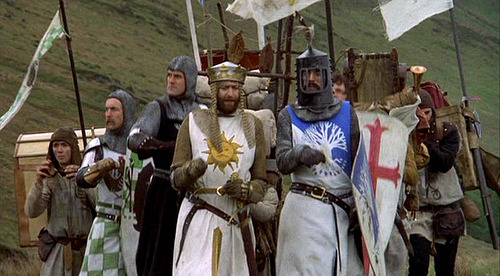
| King Arthur and his Knights in Monty Python and the Holy Grail |
Sunday, January 22, 2012
The Dream of the Rood vs. Christ II - Anglo-Saxon Cultural Change
![]() |
| 8th century Ruthwell Cross, inscription based on The Dream of the Rood |
Have you ever wondered what happened to the rich oral and literary traditions of pagan Anglo-Saxon Britain when Roman Christianity was introduced to the island in the late sixth century? How could the foreign concepts of Christianity translate into stories that the Anglo-Saxons could actually understand, and how did Christianity change the culture of England as it grew in popularity over the Germano-Norse mythology that the Angles, Jutes, and Saxons brought with them from Northern Europe?
Christian poets of Anglo-Saxon Britain faced a unique challenge in telling the story of Christ so that their audience could relate to this faith which was so fundamentally different from that of the Anglo-Saxons. The Anglo-Saxon idea of a leader was a warlord with never-fading courage and the daring to fight to the death, yet Jesus was a leader who allowed himself to be convicted of and executed for a crime of which he was innocent. In the late seventh or early eighth century, a Northumbrian poet penned The Dream of the Rood, which eloquently translated the foreign concept of Christ’s crucifixion into a language that the Anglo-Saxons could better understand. In contrast is the later work of a Mercian poet named Cynewulf, who wrote Christ II, which mainly deals with Christ’s ascension into heaven. Cynewulf also molded the Biblical story so that his audience might better connect with the events of the story. The manner in which these two poems reshape the gospel of Christ can tell the reader quite a bit about the cultural, religious, and social changes that took place in Anglo-Saxon Britain between the eighth and tenth centuries. The Anglo-Saxon religion shifted from the Norse pantheon toward Christianity, but their mead hall-centric, war-clan culture stayed much the same.
![]() |
| North face of the Ruthwell Cross |
The Dream of the Rood describes Christ as both a brave warrior and warlord. The cross (rood) says of Christ, “I trembled when the warrior embraced me,” (l. 42) and even calls Christ “heaven’s War-Lord,” (l.64) who is served by his “warrior-men” (l. 61). The Christ of the eighth century Dream of the Rood was most certainly a powerful warrior-lord and the savior of mankind, but not much else. Christ is a fairly simple character in the Dream of the Rood.
In Cynewulf’s later poem, Christ II, Jesus is no longer identified as just a warrior-lord, but as the god-lord. He is not only the gold-giver, but “their Dispenser of treasure” (l. 455), “Bestower of glory” (l. 456), and “Protector of the heaven-kingdom” (l. 563), among many other names. Christ II even analogously describes Jesus Christ as a bird, when Cynewulf writes that Job, “with the sympathy of love devised a name for the Ruler’s Son and called him a bird whom the Jews could not understand in the strength of his divine spirit," (l. 633-34). Christ as a bird is the utter opposite of the proud warrior of the Dream of the Rood. Cynewulf expanded Christ’s character so that he is not merely a warrior now, but he is gentle as a bird as well as a great ruler. The reader is merely introduced to Christ in the Dream of the Rood, but Christ is the reader’s intimate friend in Christ II, with a vast personality that can both vanquish the armies of evil (l. 558-585), and soar in the heavens like a bird.
In the Dream of the Rood, the reader is introduced to the Christian afterlife, for those who worship the warrior-Christ who died on the rood, “…where there is great bliss, delight in heaven, to where the Lord’s nation is seated at a banquet, to where the bliss is everlasting,” (Rood l. 139-42). This heaven is like a great feast that never ends, as facilitated by Christ for his faithful. The heaven of the Dream of the Rood is a place that is intended to convince the reader of the rewards of following Christ.
Descriptions of heaven in Christ II, are quite different, as heaven is now the “city of the Prince” (l. 554) in the heaven-kingdom (l. 563) instead of just a feast-hall. Cynewulf writes of all of Christ’s servants (the saints) arriving in heaven as a “radiantly clad, a shining throng. Welcome guests, they saw [Christ’s] trappings on the high throne heaven’s Ruler,” (l. 554-7). This is a grand leap from the festive, yet simple feast-hall-heaven of the Dream of the Rood. In Christ II, the reader is told of a great kingdom where all of the subjects wear rich clothing and are honored as guests of the king.
![]() |
| Page from the Exeter Book, the manuscript containing Cynewulf's Christ II |
The focus of the Dream of the Rood is on Christ and the cross. Other small details are explained, but the tale is mostly a shining and dramatic introduction to Christianity, so it does not weigh the reader down with side stories – it is an introduction to the faith of Christianity. “The time has now come that far and wide I will be worshipped by men across the earth,” speaks the cross, (l. 80-3) admonishing the dreamer who heard the cross’s story to go and share it with the rest of the world (l. 95-6). The Dream of the Rood tells the reader that Christianity has arrived (“The time has now come…” l. 80) and is the only way to partake in that eternal feast-hall after death.
The focus of Christ II is much wider than just the Ascension. Cynewulf also tells the reader of the end of the world and Christ’s return on Judgment Day, “with a great legion [to] visit again the nations of the earth and at that time judge every deed which people have committed here below the skies,” (l. 522-6) and also explains the idea of spiritual gifts that Christ “sowed and planted abundantly throughout men’s minds,” (l. 663). These are two deeper aspects of the Christian faith which might be difficult to understand without first a familiarity with the basics. Cynewulf seems to assume that his reader is already well versed in Christianity as he spends much more time embellishing than explaining.
The way in which the Dream of the Rood describes Jesus Christ as a warrior, heaven as an eternal banquet-hall, and the hope of salvation as simple and clear, demonstrates that it was written when the Anglo-Saxon reader was less likely to be familiar with the basics of Christianity. By the time Cynewulf penned Christ II, however, Christianity seems to have been fully integrated into Anglo-Saxon society, as Cynewulf’s Christ is a deep and rich character, heaven is his otherworldly kingdom, and in place of the message of salvation are several paragraphs about complicated aspects of Christianity, such as Spiritual Gifts. The Christianity of the Dream of the Rood is straightforward and easy to understand, while that of Christ II is complicated and grand. Clearly, a great shift happened in the one to two centuries between the compositions of these two poems, turning the culture of Anglo-Saxon England from one saturated in Norse mythology to one steeped in Christianity.
Saturday, May 14, 2011
Medieval Castle Construction (part I)
Today castles mostly stand in ruin: roof, floor, furniture, and any sign of life are centuries gone. Yet these structures still somehow capture our attention as we can't help but wonder what amazing stories their stone walls might tell, what great historic events transpired in their shadows? How did people manage to construct such massive structures without modern tools and machinery?Medieval castles certainly hold some marvelous secrets and seem to occupy an almost mystic role in many people's minds. They are mentioned in nearly any book related to the Middle Ages or knights, yet the number of books that consider the process of building such an imposing structure is very small in comparison. The fact that so many castles still stand, centuries after their construction, is a resounding testimony to the great skill and craftsmanship that went in to the complicated task of raising a castle.
Early versions of what we now call castles began to appear in northwest Europe in the ninth century. This also happens to be the time when the Vikings and Saracens were actively raiding across northwest Europe. In 863, Charlemagne's grandson, Charles the Bald, ordered that castles be built to defend against these invaders. Because of the decentralized nature of the Carolingian state, these castles were largely inhabited and controlled by the nobles who built them, rather than a garrison of soldiers, like earlier fortresses.
This castle-building trend barely touched England until the year 1066, when the Normans conquered England and brought a flood of castle-building in their wake. Don't think that the Anglo-Saxons did not build castles, though. It is estimated that there were roughly a half-dozen fortresses formidable enough to be considered castles at the time of the Norman invasion. This early type of castle was called a Motte-and-Bailey castle, which consisted of a steeply-sloped mound (the motte) - up to 100 feet high - with a small fortified house or tower (the keep) atop it and connected to an adjacent outer court (the bailey), or walled area, containing the soldier's quarters, stables, etc. all of which was surrounded by a ditch. The buildings were almost always constructed of timber, unless stone was readily available. These were mostly built more for the protection and benefit of the populace, such as a nearby village, rather than a noble, as per later castles.When William the Conqueror wrestled rule of England from the Anglo-Saxons in the years following 1066, his nobles needed strong centers from which to govern their new territories and castles fit the bill, so a flurry of castle-building ensued (over five hundred wooden castles by the turn of the twelfth century). A revolution in construction engineering (coupled with wealth accrued from taxes, tolls, markets, rents, and licenses) soon allowed for most of these castles to be rebuilt in stone and the castle designs grew more and more complex. For instance, builders found that corners were weak and susceptible to undermining and collapse, so they began building circular towers instead of square.
![]() |
| Bodaim Castle, built in the 14th century |
The building of a medieval castle, just like any modern construction site, employed countless workers of various skills. A whole village was needed to facilitate the construction of a castle, especially as it often took decades to complete and the laborers and craftsmen often brought their families with them. If there was not already a town or village near the castle construction site, one would likely spring up. Such was the case with Newcastle-on-Tyne, which grew from the building of Newcastle in 1080 AD.
Here are some examples of the types of workers needed for castle construction:
- Quarrymen: split the stones from a quarry and cut them roughly to shape before transporting them to the site of the construction.
- Masons: cut and shaped the stones to fit their specific place in the castle walls and then laid them. (The Master Mason was highest in command in the castle construction.)
- Carpenters: crafted and repaired tools and tool handles, scaffolding, furniture, floors, ceilings, doors, shutters, etc. (The Master Carpenter was second in command to the Master Mason.)
- Blacksmiths: made tools, door hinges, nails, horseshoes, etc.
- Potters: (when the roof was to be tile) made the thousands of roofing tiles, plus drinking jugs and such for the workers.
- Rope makers: made the rope for machinery, as well as everyday uses like bucket handles, animal leads, and belts.
- Basket weavers: wove the baskets that carried stones, food, etc. around the site.
- Plasterers and Painters: decorated the insides of finished castles to be bright and cheery.
A cast of animals were imperative to the castle-building plight, too. Donkeys and horses were needed to pull carts and haul logs and stones. Sheep's wool was used in clothing for the workers and goats provided milk for cheese. The construction process also required many ingenious machines such as the "squirrel cage" treadwheel crane. It was powered by one or two men who walked inside it and could lift a stone weighing a few tons! They also used wooden scaffolding and stone-splitting tools such as the chase-masse, (read more about the chase-masse here).The Master Mason was in charge of hundreds or thousands of workers and held the daunting task of coordinating the whole process of raising a castle. As the thousands of magnificent castles still standing across Europe testify, whether fully in tact or crumbling back into the landscape, to the immensity of his job. These castles also testify to the vast importance of a chaotic, yet glorious, part of the history of the Western world. They may stand in ruin, but they still stand.
(See the continuation of this post here.)
Subscribe to:
Posts (Atom)