Showing posts with label Norse. Show all posts

Sunday, October 20, 2013

Handmade Sami Bracelet Giveaway!

When I was in Sweden this summer, I encountered some of the most beautiful traditional arts I have ever seen in those of the indigenous Sami people of Scandinavia. The Samis are known for their exquisite work with reindeer hide, reindeer antler, and silver thread, which they work into beautiful embroidered leather bracelets, such as this one:

One of the friends I made while there is Sami, and she taught me about the art of creating Sami bracelets. I gave it a shot, and with a little practice, have begun to offer them alongside the hand-bound leather journals in my Etsy shop, Badon Hill.


Here's your chance to win one of these Sami bracelets for free! The one I am giving away has a four-part braid of silver thread, embroidered onto black reindeer leather, with reindeer antler button, all sourced from Sweden and made by me. This one is about 20 cm or 8 inches long, a good size for the average woman's wrist or a smaller-ish man's wrist. The Sami bracelet is a versatile piece, which would look great both as a formal accessory, or even with a simple pair of jeans.

Here's how you can enter the drawing:

You MUST comment on this post to enter, with your name and email address so that I can contact you if you win.
THEN you can put your name in the drawing once more for doing each of the following (and telling me which you've done in your comment):
1. Follow this blog (link is to the right).
2. Like my Facebook Page.
3. Add my shop to your favorites on Etsy.
4. Follow me on twitter.
5. Share this giveaway [only once for each; don't spam!] on Instagram, Facebook, Twitter, or Pinterest. (Please tag me @badonhill if you share on Instagram or Twitter!)

THIS GIVEAWAY HAS ENDED. I'll draw and announce the winner on Wednesday or Thursday! Thanks to everyone for entering!

Monday, August 19, 2013

Adventures in Medieval Shoe-Making! (a tutorial)


annaleshistoriae.blogspot.com
Dorestad: Old Norse Reproduction Handmade Leather Shoe by Barefoot Cordwainer on Etsy

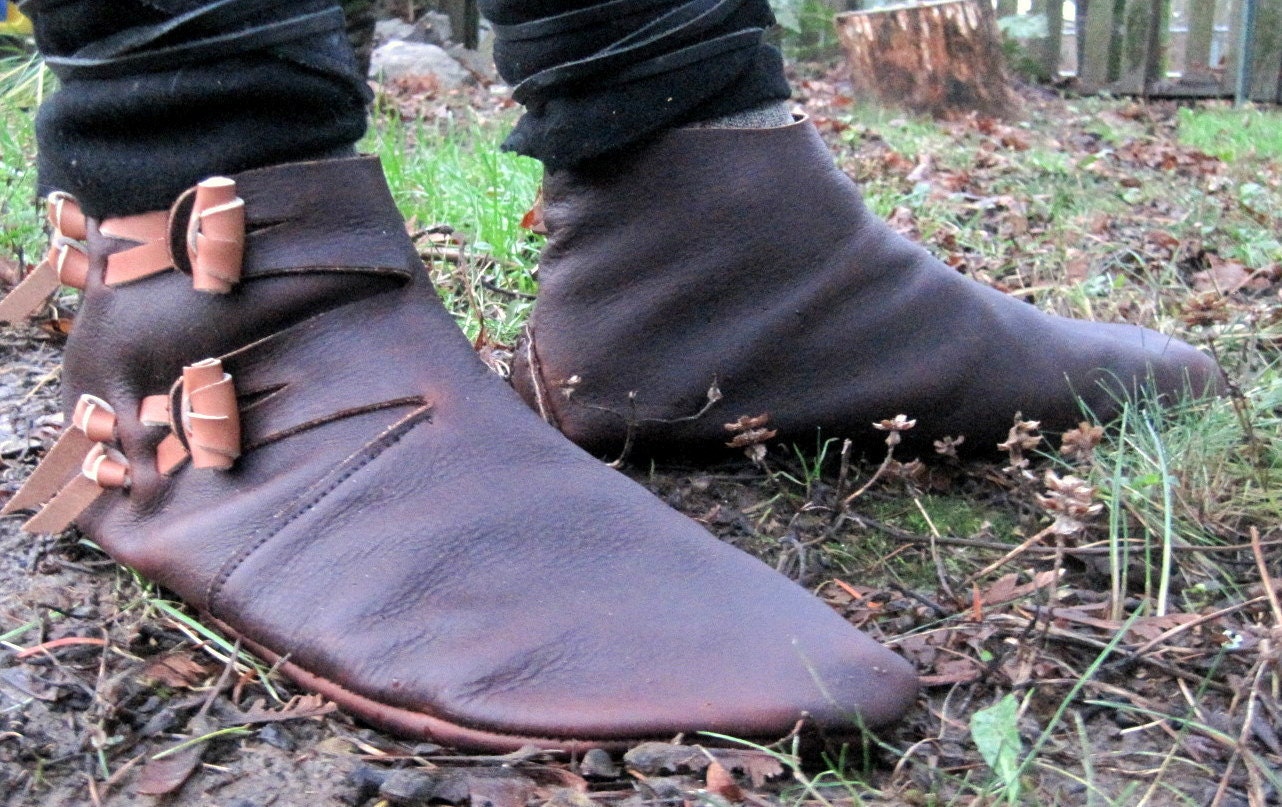
A while ago, while browsing Etsy.com, I discovered this beautiful pair of handmade shoes, reproductions of a 9th - 10th century Norse style shoe by Ian at Barefoot Cordwainer. I really loved them, but couldn't quite afford to buy them, so I thought I'd give shoe-making a shot and see if I could figure out how to make a pair for myself. I searched the internet for how-to's and tutorials on the subject, but most of what I found related to Native American style moccasins, not medieval European style shoes, so they were of little help. I ended up piecing together my process from several different sources, each of which contributed their experience to my plans.

Disclaimer: it has been over a year since I actually made my Viking shoes, and I've intended to write a post about the process since then, but seeing an actual extant example of a Viking shoe like mine in the Jorvik Museum in York, England a few weeks ago has rekindled my motivation to publish this post. So my memory of the shoe-making process might be a little spotty and I might miss some things in my explanation below. Hopefully this will still be interesting and informative for you, whether you're just curious, looking to make your own medieval shoes, or want to better appreciate the handmade shoes you're about to buy from Ian (the Barefoot Cordwainer).

Note: This is NOT a process for kids. The shoe-making process (at least how I did it) involves using sharp things in very close proximity to human flesh. And it is complicated. Please be careful.

***Possibly the Most Important Note: These shoes are supposed to fit snugly; they will conform to your feet and therefore move better with you. Make sure they're snug, but not too tight.

Supplies:


  • mock-up:
    • sock
    • sewing needle and thread
    • duct tape
    • sewing pins
    • fine-tipped pen
    • scissors
    • fabric (good if it's slightly stretchy)
  • final shoes:
    • leather (I used elk hide)
    • sewing needle and thread (specifically for leather)
    • fine-point felt-tip pen
    • an awl


Making the Mock-Up:
The mock-up will serve as the pattern for your actual shoe, and since you want your shoes to fit snugly and conform to your feet, using a well-fitting sock is important. You just need one mock-up, because you can use it as the pattern for both your right and left shoes.

Fig. 1: blue= where to draw and cut seams in duct tape sock
  1. Put the sock on your right foot and then cover the sock in duct tape. Make sure to leave the rim of the duct tape-sock where you want the tops of your shoes to sit on your ankles (or legs, if you're making boots). Don't wrap the tape too terribly tight, as you don't want to make the shoes too small, and also be sure to leave room between the sock and your foot so you can cut it off of your foot.
  2. Draw your seams onto the duct-tape sock [figure 1]. This can be a bit tricky. At this point, do not worry about the little straps that will form the closures for the shoes; you're just working to get the shape for the two main pieces of leather so that they will fit your foot properly. Draw a line around the base of your foot for the seam between the sole and body of the shoe, then another from the top of the shoe, down the center, then turning toward the sole (toward the outside of your foot) almost halfway to the tip of your foot.
  3. Cut along the seams you just drew, literally cutting the duct tape sock off of your foot. Be very careful that you don't cut your foot! You should end up with two pieces of duct taped sock: the sole, and the funky-shaped body. Flatten these out as much as possible so that the next step will be accurate.
  4. Trace the cut out duct tape sock pieces onto your fabric, then add at least a centimeter for stitching where the seams will be [figure 2]. You also need to add the triangle-ish straps at this point, which you can do by drawing the shape on a piece of paper and then adding it to the pattern for your shoe body, twice, so that you'll end up with two straps. Don't forget the little triangle heel-reinforcement piece!
    Fig. 2: tracing the duct-tape sock pieces onto the fabric

     
  5. Cut out and stitch together your new fabric mock-up. Stitch the body together first, then add the sole and heel-triangle. This is harder than it sounds, as you need to make sure that your pieces are lined up properly. You'll probably need to make some adjustments along the way. Check often to make sure that it fits on your foot and adjust accordingly. Remember that you want the shoe to be snug, but you also need to be able to wiggle your toes and get your foot in and out without straining the fabric too much.
    1. It can help immensely to mark notches in the heel and toe to help in matching the pieces up properly in the leather version.
  6. Once your mockup fits how you'd like it to, take out all of the stitching, and it can be used as the pattern for your actual leather shoes.
Making the Leather Shoes:
using the fabric mock-up as a pattern on the leather

1. Choose the parts of your leather that will make the shoes (thicker parts for the soles, softer - but not too soft! - for the upper parts) and trace your fabric pattern onto the suede (back) side of the leather accordingly. Make one set of pieces (sole, upper, heel-triangle) for each foot, and mark them on the back as you cut them. Use the pattern right side up for your right foot, then upside down for the left. Be sure to transfer the notches from your pattern to the back sides of the leather, too.


stitch together the shoe body first
2. Stitch the shoe uppers (body) together first. Depending on your materials, you might need to punch holes in the leather with an awl before stitching. Remember to stitch it inside out.
3. Stitch the soles to the uppers. Take this slowly and carefully. Remember that leather is not as forgiving as fabric, and that's why making all of the adjustments in the mock-up stage is important. Make use of the notches you marked from your pattern to be sure your soles match with the uppers properly. If you're punching holes for stitching, counting to make sure the numbers match up helps immensely. And don't forget the heel-triangles [figure 3]!

Fig. 3: sew the heel-triangle in as shown so it will look right when turned right-side-out.
 4. Construct the toggle-ties [figure 4]. You will need 4 of these, 2 for each shoe. I made these out of a slightly thicker and stiffer leather, in a lighter color (white) to accent the shoes. Cut 4 strips, each about an inch wide, and then cut them in half down most of the strip's length, leaving enough space to cut a slot to feed those two ends through in order to make the toggle's toggle-y part. (This part is difficult to explain, so hopefully the drawing helps.)


Fig. 4: constructing the toggle-ties
5. Cut the toggle-slots into the shoes and tie in your toggles [figure 5]. The toggles are adjustable, so you can make them longer or shorter as necessary, just by retying the knot! Clever, right? This is something I copied from Ian; I don't think this function goes back to the Viking age shoes. Their toggles were stitched into place, rather than knotted like these modern versions.

Fig. 5: cutting the slots for the toggles


6. You're done! Congrats! You've just created your own custom pair of Viking shoes!


annaleshistoriae.blogspot.com
After completing my shoes (whew!), I hold a new and greater appreciation for the art of shoe-making, especially with historic shoes like these. The price for a pair of good handmade leather shoes does not seem so unreasonable after spending so many hours planning and making my own shoes!


Extra Tips:

~ I bought my elk hide leather from ACS Trading Post.
~ I added some more padding to the sole by cutting a second, slightly smaller piece and using it as an inner-sole. 
~You could also make your shoes with sturdier sole-material, like vibram or rubber.
~I sealed and somewhat waterproofed my shoes by rubbing in a coat of mink oil.

I'd love to hear from you, so please post your comments, questions, or results below!

Tuesday, July 31, 2012

Harold: Last King of the Anglo-Saxons

In 1066 AD, England was yanked out of the Scandinavian world and thrust into the European world, their beautiful Anglo-Saxon society ruptured by Frankish feudalism, as Duke William of Normandy bested King Harold of England and became King William the Conqueror. Many argue that the English lost the Battle of Hastings because they had inferior military technology, poor leadership, were unprepared, etc. On the contrary, King Harold Godwinsson was a brilliant and exceptional warrior and military leader, and the English military technology easily rivaled that of the Normans. The downfall of Anglo-Saxon England was caused by circumstances far out of Harold's control: though he knew even before his coronation that waiting just over the Channel in Normandy was a threat to his crown and kingdom.[1] What Harold did not know was that he would face not one, but two separate invasions within less than one month. This would cause such fatigue that even Harold Godwinsson and his loyal army could not overcome, leading to the downfall of the English defenders at Hastings in 1066.

       A Tale of Two Battles: Harold Godwinsson (or Godwin, or Godwinson) was crowned King of England in January, 1066, as per the wishes of King Edward the Confessor and the Witan (the high council of noblemen, responsible for choosing the next king). Harold was expecting William to invade, as William believed he had been promised the English crown decades before,[2] so in early May, Harold summoned one of the largest armies England had ever seen.[3] He also called the English fleet to patrol the English Channel, waiting to fight off the expected Norman invasion fleet. But foul weather and politics kept William from sailing over the Channel, and provisions and pay ran dry by early September, so Harold dissolved the fyrd (the national army) and told the fleet to return to port.[4] Military campaigns were rare in the cold winter, so it was reasonable to assume that if William had not yet made his move, he would wait until spring.
       On September 12, however, the weather changed and allowed William of Normandy to set out for England. The Normans happened to run into the English armada and a sea-battle ensued, only to be cut short by a storm. Because of the Normans' inferior ships, they suffered great losses.[5] While Harold was at the London docks hearing of the sea battle with the Normans, a messenger arrived to warn the king that Tostig, Harold's envious and revengeful brother, had convinced King Harald Hardraada of Norway to invade England in the north.[6] Harold and his housecarls (personal guards/soldiers) immediately marched north, calling his fyrd to be gathered after him.[7]
A 19th century Norwegian depiction of the battle
      On September 20, while Harold and his men were on their way north, the two northern English earls, Edwin and Morkere confronted Hardraada and Tostig in a battle that ended with devastating losses for the English earls. Five days later, Hardraada left some of his troops to guard their fleet and set out with perhaps 10,000 men for Stamford Bridge, where he was to meet with the Northumbrian nobles so that they could formally recognize him as their king. It was a warm day, and Hardraada allowed his troops to leave their armor behind. Before the Northumbrian earls arrived, however, Harold’s fyrd of possibly 20,000 men [8] attacked the Norwegians by surprise.[9] After a full day of fighting, both Harald Hardraada and Tostig were killed, and the few remaining Norwegian soldiers were graciously allowed to retreat to their ships and leave England.[10] 
     The victory celebrations lasted six days, until a messenger brought the news that William of Normandy had landed and was devastating the land around Pevensey, in southern England.[11] Harold had 241 miles to march to meet the invaders, and Harold covered the distance averaging an incredible speed of over forty miles a day.[12]  Harold’s fyrd had suffered heavy losses at Stamford Bridge, so he called for a mass levy of every man able to fight.[13] The reinforcements which arrived in time to leave London with Harold on October 12 totaled over 4,000. More men joined Harold’s troops as they marched south toward Hastings, so that by the time the battle began on October 14, Harold’s troops numbered around 8,500.[14] 
      The core of Harold’s fyrd, the housecarls, had taken heavy casualties at Stamford Bridge, leaving Harold with no option to employ a mounted regiment, as had been so successful at Stamford Bridge.[15] Instead, the housecarls would serve as the regulating backbone of his levied army – the majority of which were now inexperienced men mostly lacking armor and armed with primitive weapons such as hayforks and clubs.[16]
      The Battle of Hastings began in the late morning, with Harold’s troops forming a strong battle line atop a ridge, forcing the Normans to charge up the hill to attack them.[17] Had all of Harold’s men been trained and experienced soldiers, the plan probably would have worked. But by late afternoon, both forces had taken heavy losses, and after one attack, the Norman cavalry turned and fled in retreat. The shire-levies (the untrained men called by the mass levy) broke from the line and pursued the fleeing Normans, battle-eager and “unaware of the danger they brought upon themselves and the whole hope of England.”[18] The retreating Normans turned around and enveloped the separated Englishmen, few of whom survived to regain the ridge. Harold had the fyrd regroup into a tight clump around his standard at the crest of the hill, but a group of Normans fought straight for the king of England and killed him.[19] Once word of the king’s death had spread among the remaining troops, they began to flee the battlefield. A small detachment of the English made a last stand against Norman pursuers by luring them to charge (to their deaths) over a ravine in the dim twilight, but the battle – and England – was lost.[20]

      Speeches, Strategy, and Stirrups: Remember how I said that scholars have blamed things such as inferior military technology and poor leadership for the downfall of the English at Hastings? Well, I don't believe that either of those were the real reason behind the English defeat. For one thing, the Anglo-Saxon chroniclers are adamantly clear that King Harold was an exceptional military leader and motivator. He was known to give eloquent and rousing speeches,[21] and was unparalleled in his ability to move his troops at astonishing speeds while marching northward to Stamford Bridge, then south to Hastings.[22]
      I even remember reading somewhere that the Normans won because they had the technology of the stirrup (which was relatively new in Europe in 1066), allowing the Norman knights to fight effectively atop horses, while the Anglo-Saxons did not have the stirrup and therefore only fought on foot (wrong, they did have stirrups). I've also read that the Anglo-Saxons did not know how to fight on horseback, though they did have stirrups - they would ride to a battle, then dismount and fight on foot. This was actually true for most of Anglo-Saxon history, but we know that Harold employed mounted warriors very effectively at the Battle of Stamford Bridge. He lost far too many horses, however, to employ similar strategy at Hastings.
      And that's where Harold's strategy comes into play. Harold had proven himself an excellent warrior and military leader long before his coronation, fighting in a series of campaigns in Wales. The chronicler Orderic Vitalis described Harold as "very tall and handsome, remarkable for his physical strength, his courage and eloquence, his ready jests and acts of valor."

      The Real Culprit: Fatigue. Most medieval battles lasted around an hour or two, ending with one side causing the other to flee the battlefield, so the descriptions of the Battle of Stamford Bridge lasting all day, and the Battle of Hastings lasting about nine hours combine for two very long and exhausting battles.[23] In addition to the fighting itself, Harold and his fyrd marched day and night for several days and then immediately begin attacking the army of Harald Hardraada upon arrival. Similarly, the march southward to London and then Hastings was also an incredible feat, as the English fyrd traveled over forty miles a day – a challenging pace even for soldiers who were mounted, and soldiers with horses accounted for less than half of Harold’s army.
      According to the U.S. Army Medical Department, “Fatigue adversely affects a person’s framework; emotional, cognitive, physical, social, and spiritual aspects are compromised.”[24] In addition to travel, chronicles tell of singing, dancing, and drinking that filled the night for the men of the fyrd. Denis Butler writes that it was likely the inexperienced new soldiers whose unthinking excitement led them to party through the night, while the veterans of Stamford Bridge and other experienced soldiers likely tried to rest while they could.[25] Drinking, dancing, and singing through the night certainly would have started those already disadvantaged soldiers – because of their lack of experience, armor, or decent weapons – at a greater disadvantage because of a lack of sleep and the exertion of the night’s merriment.

       In the End, the battle that changed the course of English history was lost for the English not because of poor leadership, technology, or lack of military expertise, but because of a series of circumstances far outside of Harold Godwinsson’s control. Certainly, other factors contributed to Harold’s demise and that of England, but the result of the compressed timing of the Battles of Stamford Bridge and Hastings was unavoidable fatigue. Though Harold’s leadership fought valiantly against the effects of the fatigue with his ability to move and motivate his troops, fatigue won out in the end and England succumbed to the Norman invasion of 1066. William pressed an unwilling Anglo-Saxon England into the Frankish-European world, and the glory of Anglo-Saxon England, along with her last king, Harold Godwinsson, breathed their last.


[1] Denis Butler, 1066: The Story of a Year, (New York: G. P. Putnam’s Sons, 1966), 27. [2] Emma Mason, The House of Godwine, (New York: Hambledon and London, 2004), 141-142. [3] Emma Mason, 143. [4] Denis Butler, 162. [5] Denis Butler, 169. [6] Denis Butler, 194. [7] Denis Butler, 169-170. [8] Denis Butler, 184. [9] Kelly DeVries, The Norwegian Invasion of England in 1066, (Woodbridge, UK: The Boydell Press, 1999), 278-279. [10] Kelly DeVries, 295. [11] Denis Butler, 203. [12] Denis Butler, 205, 210. [13] Denis Butler, 205. [14] Denis Butler, 217-220. [15] Emma Mason, 163. [16] Denis Butler, 229. [17] Edwin Tetlow, The Enigma of Hastings, (New York: St. Martin’s Press, 1974), 171. [18] Denis Butler, 243-244. [19] Denis Butler 248-249. [20] Denis Butler, 250-251. [21] Emma Mason, 157. [22] Denis Butler, 176. [23] Kelly DeVries, 270. [24] LTC Sheila Adams, “Resiliency Training for Medical Professionals,” United States Army Medical Department Journal, (April-June, 2010): 48, http://www.cs.amedd.army.mil/AMEDDJournal/2010aprjun. pdf (accessed July 13, 2012).  [25] Denis Butler, 229. 

Sunday, January 22, 2012

The Dream of the Rood vs. Christ II - Anglo-Saxon Cultural Change

8th century Ruthwell Cross, inscription
based on The Dream of the Rood

Have you ever wondered what happened to the rich oral and literary traditions of pagan Anglo-Saxon Britain when Roman Christianity was introduced to the island in the late sixth century? How could the foreign concepts of Christianity translate into stories that the Anglo-Saxons could actually understand, and how did Christianity change the culture of England as it grew in popularity over the Germano-Norse mythology that the Angles, Jutes, and Saxons brought with them from Northern Europe?


          Christian poets of Anglo-Saxon Britain faced a unique challenge in telling the story of Christ so that their audience could relate to this faith which was so fundamentally different from that of the Anglo-Saxons. The Anglo-Saxon idea of a leader was a warlord with never-fading courage and the daring to fight to the death, yet Jesus was a leader who allowed himself to be convicted of and executed for a crime of which he was innocent. In the late seventh or early eighth century, a Northumbrian poet penned The Dream of the Rood, which eloquently translated the foreign concept of Christ’s crucifixion into a language that the Anglo-Saxons could better understand. In contrast is the later work of a Mercian poet named Cynewulf, who wrote Christ II, which mainly deals with Christ’s ascension into heaven. Cynewulf also molded the Biblical story so that his audience might better connect with the events of the story. The manner in which these two poems reshape the gospel of Christ can tell the reader quite a bit about the cultural, religious, and social changes that took place in Anglo-Saxon Britain between the eighth and tenth centuries. The Anglo-Saxon religion shifted from the Norse pantheon toward Christianity, but their mead hall-centric, war-clan culture stayed much the same.

North face of the
Ruthwell Cross
The Dream of the Rood describes Christ as both a brave warrior and warlord. The cross (rood) says of Christ, “I trembled when the warrior embraced me,” (l. 42) and even calls Christ “heaven’s War-Lord,” (l.64) who is served by his “warrior-men” (l. 61). The Christ of the eighth century Dream of the Rood was most certainly a powerful warrior-lord and the savior of mankind, but not much else. Christ is a fairly simple character in the Dream of the Rood.
In Cynewulf’s later poem, Christ II, Jesus is no longer identified as just a warrior-lord, but as the god-lord. He is not only the gold-giver, but “their Dispenser of treasure” (l. 455), “Bestower of glory” (l. 456), and “Protector of the heaven-kingdom” (l. 563), among many other names.  Christ II even analogously describes Jesus Christ as a bird, when Cynewulf writes that Job, “with the sympathy of love devised a name for the Ruler’s Son and called him a bird whom the Jews could not understand in the strength of his divine spirit," (l. 633-34). Christ as a bird is the utter opposite of the proud warrior of the Dream of the Rood. Cynewulf expanded Christ’s character so that he is not merely a warrior now, but he is gentle as a bird as well as a great ruler. The reader is merely introduced to Christ in the Dream of the Rood, but Christ is the reader’s intimate friend in Christ II, with a vast personality that can both vanquish the armies of evil (l. 558-585), and soar in the heavens like a bird.

In the Dream of the Rood, the reader is introduced to the Christian afterlife, for those who worship the warrior-Christ who died on the rood, “…where there is great bliss, delight in heaven, to where the Lord’s nation is seated at a banquet, to where the bliss is everlasting,” (Rood l. 139-42). This heaven is like a great feast that never ends, as facilitated by Christ for his faithful. The heaven of the Dream of the Rood is a place that is intended to convince the reader of the rewards of following Christ.
Descriptions of heaven in Christ II, are quite different, as heaven is now the “city of the Prince” (l. 554) in the heaven-kingdom (l. 563) instead of just a feast-hall. Cynewulf writes of all of Christ’s servants (the saints) arriving in heaven as a “radiantly clad, a shining throng. Welcome guests, they saw [Christ’s] trappings on the high throne heaven’s Ruler,” (l. 554-7). This is a grand leap from the festive, yet simple feast-hall-heaven of the Dream of the Rood. In Christ II, the reader is told of a great kingdom where all of the subjects wear rich clothing and are honored as guests of the king.

Page from the Exeter Book, the manuscript
containing Cynewulf's Christ II
The focus of the Dream of the Rood is on Christ and the cross. Other small details are explained, but the tale is mostly a shining and dramatic introduction to Christianity, so it does not weigh the reader down with side stories – it is an introduction to the faith of Christianity. “The time has now come that far and wide I will be worshipped by men across the earth,” speaks the cross, (l. 80-3) admonishing the dreamer who heard the cross’s story to go and share it with the rest of the world (l. 95-6). The Dream of the Rood tells the reader that Christianity has arrived (“The time has now come…” l. 80) and is the only way to partake in that eternal feast-hall after death.
The focus of Christ II is much wider than just the Ascension. Cynewulf also tells the reader of the end of the world and Christ’s return on Judgment Day, “with a great legion [to] visit again the nations of the earth and at that time judge every deed which people have committed here below the skies,” (l. 522-6) and also explains the idea of spiritual gifts that Christ “sowed and planted abundantly throughout men’s minds,” (l. 663). These are two deeper aspects of the Christian faith which might be difficult to understand without first a familiarity with the basics. Cynewulf seems to assume that his reader is already well versed in Christianity as he spends much more time embellishing than explaining.

The way in which the Dream of the Rood describes Jesus Christ as a warrior, heaven as an eternal banquet-hall, and the hope of salvation as simple and clear, demonstrates that it was written when the Anglo-Saxon reader was less likely to be familiar with the basics of Christianity. By the time Cynewulf penned Christ II, however, Christianity seems to have been fully integrated into Anglo-Saxon society, as Cynewulf’s Christ is a deep and rich character, heaven is his otherworldly kingdom, and in place of the message of salvation are several paragraphs about complicated aspects of Christianity, such as Spiritual Gifts. The Christianity of the Dream of the Rood is straightforward and easy to understand, while that of Christ II is complicated and grand. Clearly, a great shift happened in the one to two centuries between the compositions of these two poems, turning the culture of Anglo-Saxon England from one saturated in Norse mythology to one steeped in Christianity.